Showing posts with label milkweed. Show all posts

Sunday, November 23, 2014

Food Chain in the Milkweed Patch


Common milkweed. © Beatriz Moisset
The common milkweed teems with life. Numerous insects feed on leaves, stems, and roots or sip nectar from their flowers. It is ironic that a plant so well protected by powerful toxins and sticky sap behaves like a magnet for a large assortment of creatures. The best known dependent of the common milkweed is the monarch butterfly, but there are many others that deserve our interest. Many species have found ways to overcome the defenses of this plant. They have developed resistance against the toxic cardenolides and methods to avoid the milky sap.

The herbivores are in turn eaten by other insects or spiders, which may fall prey to still other carnivores. It is worthwhile to examine one of these so called food chains or food webs.

Oleander aphids on common milkweed. © Beatriz Moisset
One milkweed feeder, the oleander aphid, has become incredibly common in recent years. This bright yellow-orange aphid was accidentally introduced in this country with oleander plants, widely used in ornamental gardening. It established itself successfully and became adapted to milkweeds. It multiplies in huge numbers near the end of the season. It can do so because females reproduce parthenogenetically, that is without help from males.

Parasitized or mummified aphids. One wasp left the corpse through a round hole. © Beatriz Moisset
This aphid has few enemies. One of them is a tiny parasitic wasp. The mother wasp lays one egg inside a growing aphid and the larva completes its entire life cycle inside the unfortunate host. By the end of the aphid's life, it becomes dark, rounded and dried up. We call that a mummy. The fully grown wasp cuts out a round hole and emerges ready to start parasitizing other members of the aphid colony. It isn't easy to see the wasps, but almost every aphid colony has some of these mummified bodies. So you know that the parasitic wasps have been around.

Parasitic wasp. © Beatriz Moisset

Lacewings, lady beetles and syrphid flies also feed on aphids. Their stories are worth telling but we'll let them be for now.

The food web does not end there. Not surprisingly, many predators visit the milkweed patch in search of animal food. Parasitic wasps seem to be a delicacy among some flies. I have found members of two different families of predatory flies dining on the wasps.

Robber fly (Taracticus octopunctatus) feeding on a parasitic wasp. © Beatriz Moisset
One is a member of the family of robber flies, Asilidae. The name describes the members of this family well. They are seen pouncing mercilessly on their prey. One of them is Taracticus octopunctatus (no common name), a slender, hunchbacked fly with large eyes.
Long-legged fly feeding on a parasitic wasp. © Beatriz Moisset
Another one is a longlegged fly, Condylostylus, a shiny metallic green fellow, with long skinny legs. Parasitic wasps are part of its menu.

I marvel about this food preference. Evidently, these flies look down on the most abundant food nearby, the aphids, and go for the far less common parasites. Perhaps, the latter have less cardenolides than the aphids and this is why the predatory flies prefer them as food.

Longlegged fly caught by a spider. © Beatriz Moisset
A second layer of predation is added to the one just described. A spider feeds on a longlegged fly. We can summarize this food chain this way:
Milkweedaphidparasitic wasppredatory flyspider

Will a bird sweep by and eat the spider? Will it in turn fall prey to a hawk or a snake? How many steps can be added to this food chain? Common milkweed feeds many members of the wild life directly and indirectly. The links of this food chain are numerous.

More on milkweed dependents and visitors

Tuesday, March 18, 2014

You can help pollinators in your own garden

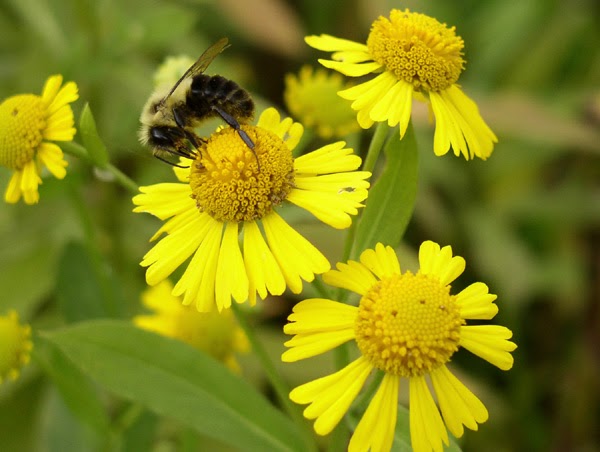
Bumble bee on Helenium © Beatriz Moisset
Plant a pollinator garden. Turn some of your lawn into a wildflower meadow. One major objection of gardeners, the fear of stings, doesn’t need to be a serious concern. Most native bees are quite different in this respect from honeybees and hornets; they hardly ever sting and if they do, it is very mild. In fact there are some, such as the Andrenids, that are incapable of doing so. Their stingers are too small to penetrate human skin.

Avoid pesticides or if you absolutely need to use them, inform yourself carefully about the specific pesticides that kill only the target species, rather than decimating many others unintentionally. Furthermore, avoiding pesticides may not be as bad as it sounds since nature has its own checks and balances and manages to keep most pests under control without resorting to pesticides. There are some cases in which use of pesticides backfires by destroying these checks and balances. Avoid herbicides also; they can be bad for pollinators. They either deprive them of food or poison them.

Fritillary on butterfly milkweed © Beatriz Moisset
Plant native flowers, that is flowers that grow locally, not just native to the United States; these are best for pollinators. Some bees may be able to adapt to non-native plants, such as many fruit trees or some of the less fancy cultivars. But native pollinators and native plants have become mutually adapted through millions of years, so they make the perfect match in most cases.

Small bee on fruit tree blossom © Beatriz Moisset
Grow a variety of flowers that bloom through the seasons. This is good for native bees; fortunately this is also what most gardeners aspire to have in their gardens. However highly selected cultivars or those with doubled-flowers don’t take care of the needs of pollinators. In general they have lost all the cues that pollinators need, such as scent. In some cases, they have also lost the pollen or nectar and so they don’t provide any food to bees.

Sunflower and bee © Beatriz Moisset

Plant the kind of lawn that provides habitat beneficial to bees. A perfectly manicured, pesticide saturated lawn is a desert to wildlife, including pollinators. Reducing the size of the lawn would benefit native pollinators. But it is also possible to have a lawn that is good for bees while being esthetically pleasing. As mentioned before, stay away from pesticides and herbicides as much as possible. Second, allow some small wildflowers; the look of your lawn may change as a result but it will continue to serve its purpose. Clover is great food for native bees; it also fixes nitrogen cutting down the need for fertilizers. Other small plants that benefit bees are ground speedwells (Veronica), wood sorrel (Oxalis acetosella), smartweeds or knotweeds (Polygonum), wild strawberries (Fragaria, several species), etc. Rather than calling them weeds we should call them grass companions or pollinator food.

Nests of solitary bees © Beatriz Moisset

Provide housing for bees. A simple bare spot here and there (no mulch or grass, just bare soil) may be enough for a few hard-working soil nesters. A sand pile may be even better. It bears repeating: There is no real need to worry about stings from solitary bees.

Dead logs or snags can supply housing for bees. You probably can’t have a dead tree on your property, but it is possible to keep a stump or a standing log and use it as an attractive planter; perhaps it will in turn provide housing for some little bees. Drilling holes on an old post or even a tree trunk would also make good nesting sites. They should be 3/32” to 3/8” in diameter and at least 4” deep.

Or you can make your own bee houses. It is possible and relatively easy to build one by following instructions posted in several websites. Or you can buy one; some resources listed below. I have discovered that watching the comings and goings of those busy mother bees can be as much fun as observing a bird house. Once again, stings don’t seem to be a real problem; I have had my face right in front of their houses and have even let them climb on my finger without any consequences.

Hollow tubes, just about the size of drinking straws, can also be used as bee nests. Some of the suppliers listed sell them. You can also tie up a bunch of hollow twigs, such as elderberry, or paper drinking straws (plastic ones are no good) together or pack them into a container such as a small milk or cream carton and place them horizontally. They should be closed at one end with the open end facing south or southeast. If you have trouble figuring out where the south is, step outside sometime between 10 AM and 1 PM and face the sun. That is how you want to place the nests. (See links below for instructions).

You can let some of your ornamental grasses stay all winter; they can be quite handsome and add variety to your winter landscape while providing nesting to your friendly native bees.

Helping the native bees would benefit us because of their invaluable services to the environment and to our gardens.

Pollinators and their multiple benefits © Beatriz Moisset


Resources
Ross, Edward S. (2003) Pollinator Conservation Handbook. The Xerces Society and The Bee Works. Portland, Oregon ISBN 0-9744475-0-1. (Bee gardens, bee houses, etc.)
The Xerces Society Guide (2011). Attracting Native Pollinators. Storey Publishing. ISBN 978-1-60342-695-4 (Everything you want to know about pollinators and their conservation)
Urban Bee Gardens. Berkeley University
Nests for Native Bees. The Xerces Society
Bee houses. National Wildlife Federation. (How to build a bee house)

Sellers of bee houses
Knox Cellars.
Mason bee homes.


List of articles
Beginners Guide to Pollinators and Other Flower Visitors


© Beatriz Moisset. 2014

Friday, July 12, 2013

Milkweeds, Monarchs and More: The Milkweed Community

Monarch butterfly, adult female. It nectars on a variety of flowers
Monarch caterpillar, It feeds only on milkweeds
Monarch butterflies capture our hearts with their beauty and intrepid globe trotting. We have learned that the caterpillars need milkweeds to grow into the magnificent winged creatures. As a consequence, many gardeners gladly grow these plants in their yards and welcome the arrival of the travelers. They eagerly follow the appearance of the tiny caterpillars, their growth and final metamorphosis.

This leads many to learn more about these plants, their toxicity and the other visitors attracted by the overpowering sweet aroma of the flowers. Some gardeners don’t see them as weeds anymore but as nice additions to their butterfly gardens. Did you know that there are more than 100 species of milkweeds or Asclepias in North America? Did you know that monarchs are not the only ones that depend on milkweeds? Many other insects do. The whole story is infinitely more complex than just milkweed plant/monarch butterfly. A patch of milkweed plants is a community with many herbivores taking advantage of it, followed by carnivores, not to mention numerous pollinators.

Some of the members of this community depend exclusively on milkweeds while others benefit from these plants, but have other food choices. Pollinators and predators, fall in the second category.
Let us take a look at those that are dependent on milkweeds, those which need these plants to complete their development from egg, through immature or larval stages to adulthood. Some eat leaves; others go for stems, roots or seeds. Their tastes can be highly selective, feeding on only one or at most two species of milkweeds. Others, like the monarch butterfly, have broader tastes and accept most species of milkweeds or even some related plants. It is the growing insects that are dependent. The adults, in turn, may not need milkweeds, but they frequent these plants to lay their eggs on them.

Milkweeds have developed an assortment of defenses, such as sticky latex, hairy leaves and powerful toxins, against the cadre of hungry feeders. The eaters, in turn, have gradually found ways to overcome every one of these barriers. Milkweeds respond by producing more latex, hairier leaves, and stronger toxins. In this eternal arms race nobody wins, but nobody loses either. Like a carefully choreographed ballet, the equally matched enemies continue this dance of life and death affecting each other and in turn influencing the other members of the community.


Delicate cycnia (Cycnia tenera)
Its caterpillars feed on milkweeds
The best known, of course, is the monarch butterfly. Let us not forget its close relatives, the queen and the soldier butterflies. It is worth mentioning that a few other relatives live in South America and Africa. They are all fairly flexible and can resort to more than one species of milkweed.

Milkweed tussock moth caterpillar
feeding on common milkweed

Among the moths dependent on milkweed, the delicate cycnia (Cycnia tenera), with a very appropriate name, relies only on common milkweed and swamp milkweed. The milkweed tussock moth (Euchaetes egle) has broader tastes and can live on several species of milkweed.

Red milkweed beetle (Tetraopes tetrophthalmus)
feeds on common milkweed
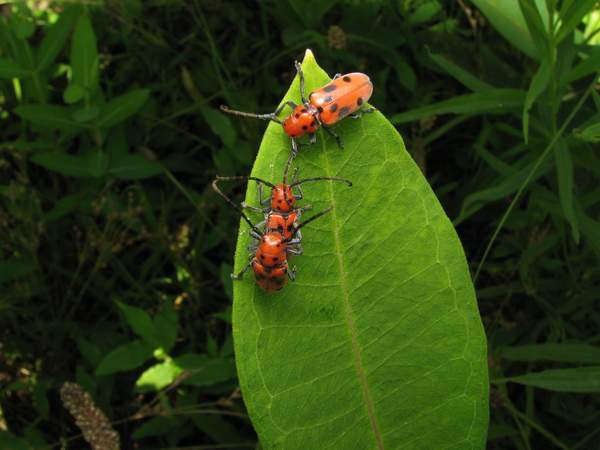
Moving on to other dependents we find beetles. We are most familiar with the milkweed longhorned beetle, often found on common milkweed. If we translate the scientific name of the most familiar one, Tetraopes tetrophthalmus, we would call it the four-eyed four-eyes, although it is known as the red milkweed beetle. The peculiar eyes of all the Tetraopes beetles are divided by the base of the antennae, hence the name. But it gets more complicated because instead of just one species there are at least 14 related and similarly looking species of four-eyed milkweed beetles. Each species sticks to only one or at most two species of milkweed. For instance, the red milkweed beetle feeds only on common milkweed, the red-femured milkweed borer on showy milkweed, and the blackened milkweed beetle on swamp milkweed.

The list goes on and on. It includes beetles of several families. For the sake of briefness see images of a few of them.

Swamp milkweed beetle larva (Labidomera clivicolis)
feeding on milkweed


Dogbane beetle. Larva feeds on dogbane or milkweed

Milkweed stem weevil (Rhyssomatus lineaticollis)
Larvae of several species feed on milkweeds

Small milkweed bug (Ligaeus kalmii)
Large milkweed bugs (Oncopeltus fasciatus)

Let us take a look at the milkweed bugs. The most familiar ones are the large milkweed bug (Oncopeltus fasciatus) and the small milkweed bug (Lygaeus kalmii). Curiously, despite their names, they are not entirely dependent on milkweed. They have been seen feeding on other plants, and even on other insects, in the case of the small milkweed bug.

Milkweed aphid (Myzocallis asclepiadis)
feeding on common milkweed

Several kinds of aphids attack milkweeds. Two of them are dependent on common milkweed. They are Aphis asclepiadis, and Myzocallis asclepiadis; no common name for these either.

All these and many more feed on milkweeds, some on only one species, others on several or many.

When we nurture monarch butterflies by planting milkweeds we are doing more than aiding the butterflies. We are helping the entire milkweed community or series of communities. The members of such communities or ecosystems interact with each other and, in turn, with a wide arrangement of other participants of this intricate play, such as neighboring plants and soil organisms. By preserving the habitat of monarchs, we are also preserving biodiversity. All species are important and we need to respect these communities and learn more about them.
Large milkweed bugs (Oncopeltus fasciatus)

See also:
Food Chain in the Milkweed Patch

 
References

Saturday, November 24, 2012

Milkweed's last hooray. Part two

Polished lady beetle (Cycloneda munda) on dying milkweed leaf

The milkweed food chain would be incomplete without predators and parasitoids. Most of them are out of sight in November; but a few are around feeding on whatever is available, mostly aphids.

Multicolored Asian lady beetle (Harmonia axyridis) pupa
Two species of ladybugs or lady beetles find abundant food on the dying milkweeds. A shiny adult polished lady beetle (Cycloneda munda) may be getting ready to hibernate. A little farther a pupa of the multicolored Asian lady beetle (Harmonia axyridis) stays still on a leaf. It is rather infrequent to find one so exposed. This one is darker than most pupae of this species, but as its name indicates, color variations abound. In another month it would become an adult, out of its pupa. It would turn out darker than most of its kind.

Multicolored Asian lady beetle adult


 Another type of aphid eater is present in numbers and feeds on the two species of aphids mentioned in the previous post. The larvae of syrphid flies are blind and worm-like, lacking legs. Despite these disadvantages, they have no trouble finding aphids to feed upon, provided that the mother was careful enough to lay her eggs near a growing and prosperous colony of aphids.
Syrphid larva (Eupeodes americanus)

It is impressive to see these maggots thrashing around until they find a plump juicy aphid. They hold it with their strong mouth parts and proceed to suck all the internal fluids until the prey is reduced to a deflated piece of skin. You can see the front end of the larva acting as a pump, expanding and contracting. Oddly, the other aphids in the colony have no fear, no premonition of what is in store for them. I have seen them approaching and then walking all over a syrphid maggot in total indifference.


Syrphid larva (Eupeodes americanus)
 
In a couple of weeks this will be all over. No more active life in the milkweed patch; just a few flying seeds carried by their fluff. The monarchs are long gone. All others remain in the area in hidden places safe from the weather and from the occasional winter predator. They will all return to their usual activities next year, when the milkweeds start sprouting new shoots and providing nourishment to them.


Milkweed's last hooray
List of articles

© Beatriz Moisset. 2012