Showing posts with label ladybug. Show all posts

Sunday, August 17, 2014

Ladybugs, Praying Mantis, and other So-called Beneficials. Are They?

The native polished lady beetle, a good one
I recently published an article on ladybugs, better called lady beetles, in Native Plants and Wildlife Gardens. My purpose was to explain that not all lady beetles are beneficial. Unfortunately some are introduced species which disrupt the ecosystems, competing with and even killing some of the native ones.

Polished lady beetle larva (Cycloneda munda)

In writing the article and later reading people's responses, a more serious problem caught my attention. Companies that sell lady beetles are causing more damage than good. Well-intentioned gardeners buy them without realizing the consequences of introducing non-native lady beetles or the pests that they carry.

An invasion of Asian lady beetles. More trouble than they are worth
This led me to want to learn more about other bio-controls or biological pests controls being sold to unwary gardeners. I will be writing in the future about praying mantis and their commercialization. This seems to be a bigger problem than that of lady beetles. For now, just look at these pictures. More coming up later on.

Tenodera sinensis sinensis (Chinese Mantid)


List of articles

© Beatriz Moisset. 2013


Saturday, November 24, 2012

Milkweed's last hooray. Part two

Polished lady beetle (Cycloneda munda) on dying milkweed leaf

The milkweed food chain would be incomplete without predators and parasitoids. Most of them are out of sight in November; but a few are around feeding on whatever is available, mostly aphids.

Multicolored Asian lady beetle (Harmonia axyridis) pupa
Two species of ladybugs or lady beetles find abundant food on the dying milkweeds. A shiny adult polished lady beetle (Cycloneda munda) may be getting ready to hibernate. A little farther a pupa of the multicolored Asian lady beetle (Harmonia axyridis) stays still on a leaf. It is rather infrequent to find one so exposed. This one is darker than most pupae of this species, but as its name indicates, color variations abound. In another month it would become an adult, out of its pupa. It would turn out darker than most of its kind.

Multicolored Asian lady beetle adult


 Another type of aphid eater is present in numbers and feeds on the two species of aphids mentioned in the previous post. The larvae of syrphid flies are blind and worm-like, lacking legs. Despite these disadvantages, they have no trouble finding aphids to feed upon, provided that the mother was careful enough to lay her eggs near a growing and prosperous colony of aphids.
Syrphid larva (Eupeodes americanus)

It is impressive to see these maggots thrashing around until they find a plump juicy aphid. They hold it with their strong mouth parts and proceed to suck all the internal fluids until the prey is reduced to a deflated piece of skin. You can see the front end of the larva acting as a pump, expanding and contracting. Oddly, the other aphids in the colony have no fear, no premonition of what is in store for them. I have seen them approaching and then walking all over a syrphid maggot in total indifference.


Syrphid larva (Eupeodes americanus)
 
In a couple of weeks this will be all over. No more active life in the milkweed patch; just a few flying seeds carried by their fluff. The monarchs are long gone. All others remain in the area in hidden places safe from the weather and from the occasional winter predator. They will all return to their usual activities next year, when the milkweeds start sprouting new shoots and providing nourishment to them.


Milkweed's last hooray
List of articles

© Beatriz Moisset. 2012 

Thursday, November 15, 2012

Milkweed's last hooray


Striped garden caterpillar, Trichordestra legitima

It is November. We are deep into autumn. Monarch butterflies stopped feeding on milkweeds and are long gone from this area. Milkweeds are wilting, dropping leaves, some covered with sooty mold, and others reduced to dry stems and seed pods. Still they continue to nourish and shelter a number of species that depend on them.

A noctuid moth, the striped garden caterpillar moth (Trichordestra legitima), spends the winter as a pupa. An occasional caterpillar hangs around this late in the season taking advantage of the last scraps of food. Unlike monarchs, it is not choosy. This one happens to be feeding on common milkweed but others find nourishment in an incredible assortment of plants, from asparagus to yarrow or tobacco.

Oleander aphid, Aphis nerii

Aphids are busy sucking juices from the few remaining green stems and leaves of milkweeds. Their colonies are usually considerably larger this time of the year. The most frequent species on common milkweed is the oleander aphid (Aphis nerii), a bright yellow-orange one.
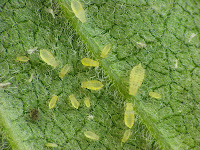
Myzocallis asclepiadis
Less common is the aphid called only by its scientific name, Myzocallis asclepiadis, about the same size as the oleander aphid, almost translucent, with dark dots and often seen sharing plants with its more colorful relative. Myzocallis asclepiadis specializes on Asclepias, as its name suggests. The oleander aphid has broader tastes, living on other members of the dogbane family (Apocinaceae), as well as occasionally some plants of the potato family. This aphid is not native to this hemisphere, and, curiously, there are no males in the North American populations, so they only reproduce parthenogenetically or by virgin birth.

Labidomera clivicollis, larva
Labidomera clivicollis
 A colorful beetle, the swamp milkweed leaf beetle (Labidomera clivicollis) is not as selective as its name indicates and also feeds on common milkweed, as this larva was doing. It is unusual to find a larva still feeding in November. There was an adult nearby.


large milkweed bug, Oncopeltus fasciatus
A common denizen of dry and dying milkweeds is the large milkweed bug (Oncopeltus fasciatus). Both adults and juveniles (called nymphs) feed on seeds of this plant as well as leaves. So it is not surprising to see them in large numbers in November.
Soon all these milkweed visitors will be gone, too. The one that will remain will be the longhorned milkweed beetle (Tetraopes tetrophthalmus). Its larvae will remain buried underground feeding on roots and waiting for next spring.


Beginners Guide to Pollinators and Other Flower Visitors

© Beatriz Moisset. 2012

Thursday, June 28, 2012

Don't Kill Your Friends

Larva of Coleomegilla maculata, pink spotted lady beetle © Beatriz Moisset
Please, don't go about killing any bug in sight. Some of the ugly ones are your best friends. Take the little "alligator" shown here. If you look closely you will notice that it is devouring aphids.

Same as above, notice the aphids being eaten © Beatriz Moisset
 
The aphids escape notice at first sight. They are the ones that are sapping the juices from your plants and this little guy is going around vacuuming them as fast as it can.

Adult Coleomegilla maculata on spring beauty © Beatriz Moisset
And here is the kicker, that ugly bug will turn into a ladybug when it is fully grown.And remember that it probably eats more aphids at this stage than when it is fully grown. So, if you think about it, maybe it isn't ugly after all. It is beginning to look rather pretty, don't you think?

Polished lady beetle © Beatriz Moisset

List of Articles

© Beatriz Moisset. 2012