Showing posts with label milkweed aphid. Show all posts

Tuesday, August 10, 2021

Aphids, how many is too many?

                                        Microsiphum aphids on rose bush


I read somewhere (I wish I could find that reference now) that the aphid biomass in an acre of meadows can be equivalent to that of an elephant. Perhaps that is a gross exaggeration, but, even if it was comparable to the mass of a cow or a dog, that is a lot of aphids. Let us face the facts: aphids are here in our gardens in substantial numbers, whether we see them or not. I am sure that I have eaten my share of them on leaves of lettuce, and you have done so too.

Is that a bad thing? Probably not, as long as there are only a few per plant. They don’t cause serious damage and they form part of the food chain, nourishing numerous kinds of wildlife, small and large. Aphid populations can be kept in check by the combined action of all those eaters most of the time. It is a beautiful system when it works well, but sometimes it gets disrupted.

Ecologists explain repeatedly that trouble often arises when pesticides wipe out not just the aphids, but their predators. Predator populations take longer to recover, allowing newly arrived aphids to explode in numbers before balance is reestablished.

I have been looking for these aphid controls in my garden. There is a whole assortment. Usually ladybugs take most of the credit, but others are just as effective or even more so, although less visible: parasitic wasps, flower flies and lacewings, among others. Some small birds, such as nuthatches and chickadees have been seen eating aphid eggs in winter.

Syrphid fly larva feeding on aphids


Syrphid flies, also called flower flies or hover flies interest me the most because they provide another important service in the garden: they are pollinators. The adult flies spend a lot of time hovering over flowers. They land on them to feed on pollen and nectar and to meet partners and mate. Their two common names refer to these behaviors. They look very much like bees, giving rise to amusing mistakes of which I have collected a few illustrations: a book named “Bees of the World”, a business card for a shop called “The Bees Knees” and an article on bees on the French newspaper, Le Figaro. In all these cases the image is not that of a bee but of an impersonator, a fly. If you know of any other examples, please let me know, so I can add them to my list.

The larvae of some of them, those called Syrphini, feed on aphids. The females are very good at spotting incipient populations of aphids and laying their eggs nearby. When the maggots emerge from the eggs they go right to work and can dispose of dozens of aphids in the ten days or so that it takes to complete their growth.

To learn more about their life cycle I collected some, kept them well supplied with aphids and saw them grow to full size, become pupae and finally emerge as adults. I took pictures and videos of the whole thing. The videos may be gross but fascinating. A maggot blindly thrashes around until it finds an aphid, pierces its skin and proceeds to suck it dry, discarding the shriveled husk. The whole process takes only a few minutes. It resumes its search right away. No wonder they can be so good at controlling aphid populations!

Another form of trouble occurs when new species of aphids are introduced into an ecosystem. This doesn't happen intentionally, but aphids easily travel with their host plants and may be able to adapt to related plants found in their new home.


Oleander aphids on milkweed

Such is the case of the oleander aphid. It has adapted to plants of the genus Asclepias, the milkweeds, and it can wreak havoc on them. It multiplies in large numbers, free from its habitual restrains. A few species parasitize of predate on oleander aphids, such as some parasitic wasps and lacewings and ladybugs, but all them together are not enough to keep the populations of oleander aphids under control.

Friday, July 12, 2013

Milkweeds, Monarchs and More: The Milkweed Community

Monarch butterfly, adult female. It nectars on a variety of flowers
Monarch caterpillar, It feeds only on milkweeds
Monarch butterflies capture our hearts with their beauty and intrepid globe trotting. We have learned that the caterpillars need milkweeds to grow into the magnificent winged creatures. As a consequence, many gardeners gladly grow these plants in their yards and welcome the arrival of the travelers. They eagerly follow the appearance of the tiny caterpillars, their growth and final metamorphosis.

This leads many to learn more about these plants, their toxicity and the other visitors attracted by the overpowering sweet aroma of the flowers. Some gardeners don’t see them as weeds anymore but as nice additions to their butterfly gardens. Did you know that there are more than 100 species of milkweeds or Asclepias in North America? Did you know that monarchs are not the only ones that depend on milkweeds? Many other insects do. The whole story is infinitely more complex than just milkweed plant/monarch butterfly. A patch of milkweed plants is a community with many herbivores taking advantage of it, followed by carnivores, not to mention numerous pollinators.

Some of the members of this community depend exclusively on milkweeds while others benefit from these plants, but have other food choices. Pollinators and predators, fall in the second category.
Let us take a look at those that are dependent on milkweeds, those which need these plants to complete their development from egg, through immature or larval stages to adulthood. Some eat leaves; others go for stems, roots or seeds. Their tastes can be highly selective, feeding on only one or at most two species of milkweeds. Others, like the monarch butterfly, have broader tastes and accept most species of milkweeds or even some related plants. It is the growing insects that are dependent. The adults, in turn, may not need milkweeds, but they frequent these plants to lay their eggs on them.

Milkweeds have developed an assortment of defenses, such as sticky latex, hairy leaves and powerful toxins, against the cadre of hungry feeders. The eaters, in turn, have gradually found ways to overcome every one of these barriers. Milkweeds respond by producing more latex, hairier leaves, and stronger toxins. In this eternal arms race nobody wins, but nobody loses either. Like a carefully choreographed ballet, the equally matched enemies continue this dance of life and death affecting each other and in turn influencing the other members of the community.


Delicate cycnia (Cycnia tenera)
Its caterpillars feed on milkweeds
The best known, of course, is the monarch butterfly. Let us not forget its close relatives, the queen and the soldier butterflies. It is worth mentioning that a few other relatives live in South America and Africa. They are all fairly flexible and can resort to more than one species of milkweed.

Milkweed tussock moth caterpillar
feeding on common milkweed

Among the moths dependent on milkweed, the delicate cycnia (Cycnia tenera), with a very appropriate name, relies only on common milkweed and swamp milkweed. The milkweed tussock moth (Euchaetes egle) has broader tastes and can live on several species of milkweed.

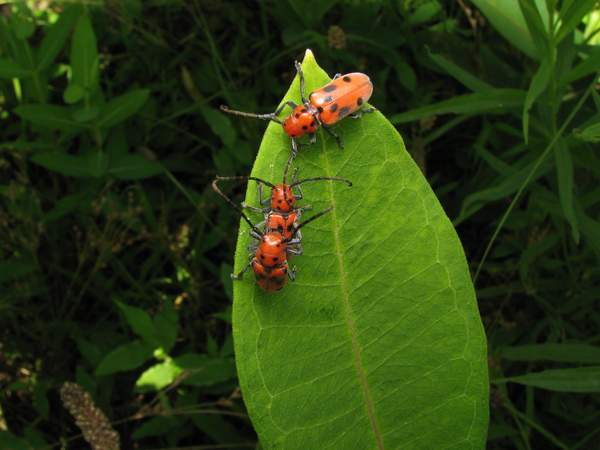
Red milkweed beetle (Tetraopes tetrophthalmus)
feeds on common milkweed
Moving on to other dependents we find beetles. We are most familiar with the milkweed longhorned beetle, often found on common milkweed. If we translate the scientific name of the most familiar one, Tetraopes tetrophthalmus, we would call it the four-eyed four-eyes, although it is known as the red milkweed beetle. The peculiar eyes of all the Tetraopes beetles are divided by the base of the antennae, hence the name. But it gets more complicated because instead of just one species there are at least 14 related and similarly looking species of four-eyed milkweed beetles. Each species sticks to only one or at most two species of milkweed. For instance, the red milkweed beetle feeds only on common milkweed, the red-femured milkweed borer on showy milkweed, and the blackened milkweed beetle on swamp milkweed.

The list goes on and on. It includes beetles of several families. For the sake of briefness see images of a few of them.

Swamp milkweed beetle larva (Labidomera clivicolis)
feeding on milkweed


Dogbane beetle. Larva feeds on dogbane or milkweed

Milkweed stem weevil (Rhyssomatus lineaticollis)
Larvae of several species feed on milkweeds

Small milkweed bug (Ligaeus kalmii)
Large milkweed bugs (Oncopeltus fasciatus)

Let us take a look at the milkweed bugs. The most familiar ones are the large milkweed bug (Oncopeltus fasciatus) and the small milkweed bug (Lygaeus kalmii). Curiously, despite their names, they are not entirely dependent on milkweed. They have been seen feeding on other plants, and even on other insects, in the case of the small milkweed bug.

Milkweed aphid (Myzocallis asclepiadis)
feeding on common milkweed

Several kinds of aphids attack milkweeds. Two of them are dependent on common milkweed. They are Aphis asclepiadis, and Myzocallis asclepiadis; no common name for these either.

All these and many more feed on milkweeds, some on only one species, others on several or many.

When we nurture monarch butterflies by planting milkweeds we are doing more than aiding the butterflies. We are helping the entire milkweed community or series of communities. The members of such communities or ecosystems interact with each other and, in turn, with a wide arrangement of other participants of this intricate play, such as neighboring plants and soil organisms. By preserving the habitat of monarchs, we are also preserving biodiversity. All species are important and we need to respect these communities and learn more about them.
Large milkweed bugs (Oncopeltus fasciatus)

See also:
Food Chain in the Milkweed Patch

 
References