Showing posts with label ecosystem. Show all posts

Tuesday, August 10, 2021

Aphids, how many is too many?

                                        Microsiphum aphids on rose bush


I read somewhere (I wish I could find that reference now) that the aphid biomass in an acre of meadows can be equivalent to that of an elephant. Perhaps that is a gross exaggeration, but, even if it was comparable to the mass of a cow or a dog, that is a lot of aphids. Let us face the facts: aphids are here in our gardens in substantial numbers, whether we see them or not. I am sure that I have eaten my share of them on leaves of lettuce, and you have done so too.

Is that a bad thing? Probably not, as long as there are only a few per plant. They don’t cause serious damage and they form part of the food chain, nourishing numerous kinds of wildlife, small and large. Aphid populations can be kept in check by the combined action of all those eaters most of the time. It is a beautiful system when it works well, but sometimes it gets disrupted.

Ecologists explain repeatedly that trouble often arises when pesticides wipe out not just the aphids, but their predators. Predator populations take longer to recover, allowing newly arrived aphids to explode in numbers before balance is reestablished.

I have been looking for these aphid controls in my garden. There is a whole assortment. Usually ladybugs take most of the credit, but others are just as effective or even more so, although less visible: parasitic wasps, flower flies and lacewings, among others. Some small birds, such as nuthatches and chickadees have been seen eating aphid eggs in winter.

Syrphid fly larva feeding on aphids


Syrphid flies, also called flower flies or hover flies interest me the most because they provide another important service in the garden: they are pollinators. The adult flies spend a lot of time hovering over flowers. They land on them to feed on pollen and nectar and to meet partners and mate. Their two common names refer to these behaviors. They look very much like bees, giving rise to amusing mistakes of which I have collected a few illustrations: a book named “Bees of the World”, a business card for a shop called “The Bees Knees” and an article on bees on the French newspaper, Le Figaro. In all these cases the image is not that of a bee but of an impersonator, a fly. If you know of any other examples, please let me know, so I can add them to my list.

The larvae of some of them, those called Syrphini, feed on aphids. The females are very good at spotting incipient populations of aphids and laying their eggs nearby. When the maggots emerge from the eggs they go right to work and can dispose of dozens of aphids in the ten days or so that it takes to complete their growth.

To learn more about their life cycle I collected some, kept them well supplied with aphids and saw them grow to full size, become pupae and finally emerge as adults. I took pictures and videos of the whole thing. The videos may be gross but fascinating. A maggot blindly thrashes around until it finds an aphid, pierces its skin and proceeds to suck it dry, discarding the shriveled husk. The whole process takes only a few minutes. It resumes its search right away. No wonder they can be so good at controlling aphid populations!

Another form of trouble occurs when new species of aphids are introduced into an ecosystem. This doesn't happen intentionally, but aphids easily travel with their host plants and may be able to adapt to related plants found in their new home.


Oleander aphids on milkweed

Such is the case of the oleander aphid. It has adapted to plants of the genus Asclepias, the milkweeds, and it can wreak havoc on them. It multiplies in large numbers, free from its habitual restrains. A few species parasitize of predate on oleander aphids, such as some parasitic wasps and lacewings and ladybugs, but all them together are not enough to keep the populations of oleander aphids under control.

Sunday, October 11, 2020

In Praise of Dead Old Trees

What to do with that dead tree in your yard? In a forest even a dead tree has its place providing homes and food to a variety of wildlife, what about the one in your property? You could leave it standing instead of cutting it down to the ground. You may have to remove some of the branches for safety reasons and keep only the trunk and main branches. Of course your neighbors and visitors may frown upon such untidiness. What can you say to them? You may tell them that it is an abstract sculpture. A dead tree isn't lacking in beauty but we are so obsessed with tidiness and the manicured look that it takes a readjustment of our esthetic vision to accept such a sight. Look at the architecture of the branches, the subtle hues of the weathered wood, the contrast between its stark lines and the exuberant greenery of the rest of your yard and you will begin to notice that it adds an interesting note to the whole.

In addition to its esthetic value a dead tree can become a home to numerous valuable pollinators, native bees that take advantage of the holes drilled by beetle larvae; also a dead tree may be very beneficial to woodpeckers, which may even prefer it to your live trees and leave them alone. And remember that when you are leaving that dead tree in your yard you are not really doing the pollinators and woodpeckers a favor but allowing them to have what is legitimately theirs. This is the way of Nature, all these creatures contribute to the ecological balance.

If you want to help the native bees even further, you can drill a few holes in the dead wood, they should be about the width of an ordinary pencil (they can be a little wider or a little narrower, there are so many species of bees that they come in several different sizes). The holes should be about six to eight inches long, slightly slanted upwards to protect them from the rain and they should face south or south east so the sun warms them up in the morning. I hope that next spring you get a few tenants in your bee condo.

Wednesday, October 09, 2013

The Dancing Grasses


Pennypack meadows in the fall. © Beatriz Moisset. 2009
That autumn day, it was windy but sunny and pleasant in the meadows of Pennypack. The fields looked more alluring than ever, dressed on their ochres, tans and scarlets. The breeze played fantastic tricks on the assortment of tall grasses planted in recent years to restore the meadows to their former glory before farming and mowing had converted them into dull lawns.

Sunlight puts a sparkle on the grasses. © Beatriz Moisset. 2009
Each gust of wind made the grasses dance, sometimes a slow minuet, others a wild disco. We stood there mesmerized. No manicured meadow could produce the glorious spectacle that we observed that day.

It is fall again. When the rain ceases, we will visit the meadows and fill our hearts on their beauty and peace. Perhaps a swallow will slice the sky in its way to South America. Perhaps we'll hear the buzz of a late bumble bee before it retires to its winter sleeping place. The dancing grasses are calling us.

The wind sends the grasses dancing. © Beatriz Moisset. 2009

List of Articles

Beginners Guide to Pollinators and Other Flower Visitor

© Beatriz Moisset. 2013

Tuesday, October 08, 2013

Goldenrods and their Dependent Fauna

Blue-winged wasp on goldenrod

Goldenrods are magnets for a wide variety of animal life. I am talking about the six-legged and eight-legged fauna, insects and spiders.

I enjoy leading walks in the fall to observe all the bounty of tiny wildlife buzzing, zipping along, and crawling and hiding in the goldenrod patch. I call this program "The goldenrod zoo". My favorites are the pollinators; but I also like to point out the various kinds of galls and their amazing makers and residents.

Goldenrods used to be regarded as weeds in North America; many people still see them that way. Recently I heard a gardener, an organic gardener at that, who wants to eliminate them from her property. This made me think about the beneficial qualities of goldenrods, both to wildlife in general and to gardens in particular. So I started a list.
Goldenrod round galls in winter. One of them has been opened by a chickadee


Round galls are produced in the stems of tall goldenrods by a species of flies (the goldenrod fly). Gail Eichelberger described the fly’s life cycle in "The Gall of That Goldenrod" in "Beautiful Wildllife Garden." She also mentioned how the gall fly larvae can serve as food for chickadees and downy woodpeckers during the winter months. I will simply add that you can tell which of these two birds has opened each gall. Downies skillfully chisel a clean hole, while chickadees are sloppier, and destroy a good part of the gall to get to the prize.

There are a few other types of galls, produced by moths or flies, many of these insects also provide food for birds.
Sweat bee Agapostemon

Sweat bee Augochloropsis
Let us take a look at the goldenrod flowers visitors. There are at least 380 species that visit just one species, the Canada goldenrod (Solidago Canadensis). Not all of them are pollinators and many visit other flowers besides goldenrod. But they all benefit from these flowers’ nectar and pollen.
Syrphid fly, a good aphid control

Feather-legged fly, Tachinidae

Leaf-footed bug. Notice the tachinid fly eggs on its head
Here I am listing a few whose larvae feed on other insects, so they provide an important ecosystem service as biological controls. The larvae of some Syrphid flies feed on aphids. Tachinid flies lay their eggs on other insects especially on stink bugs or related bugs which feed on plants.

Potter wasp


Wasps of many kinds are very abundant in the fall, so perhaps they are the most common visitors of goldenrod flowers. They include not just the more familiar and feared ones, hornets and yellow jackets, but also many solitary ones, which are less likely to sting. All of them catch insects or spiders to feed their larvae.

There is one in particular that has become a favorite of mine, the large and colorful blue-winged wasp, Scolia dubia. It is rather hairy and heavy-bodied, unlike most wasps. Its wings are supposedly blue, as the name suggests. But you need a little imagination, or the sunlight hitting them just right; otherwise they look smoky. The body is very dark blue-black, except for the last few segments of the abdomen which are reddish or orange with two bright large yellow spots.

The nice thing about this wasp is that its offspring feeds on the larvae of June beetles. The females spend a good deal of time searching the ground for beetle larvae and digging them out; this earns them their other common name: digger wasp. When a female wasp finds a grub, it paralyzes it. Then it digs a little deeper, builds a small chamber, and lays an egg on its victim. Gruesome, yes, but effective.

And here comes the best part: The blue-winged wasp has developed a taste for Japanese beetles and treats them the same way as June beetles. We all know that one of the most serious problems with introduced pests such as this is that they have left most of their enemies behind in the old country, so they can multiply unchecked. The USDA tried unsuccessfully to introduce some relatives of this wasp as biocontrols of the Japanese beetle. So it is wonderful to see that a native insect has become an enemy of the invasive pest.
Blue-winged wasp
Here’s to the blue-winged wasp and to the goldenrods that sustain it in the fall!

First published in "Native Plants and Wildlife Gardens" as "Goldenrod, a Weed or a Treasure?"


Beginners Guide to Pollinators and Other Flower Visitors

All photos by Beatriz Moisset. All rights reserved
© Beatriz Moisset. 2013


Friday, July 12, 2013

Milkweeds, Monarchs and More: The Milkweed Community

Monarch butterfly, adult female. It nectars on a variety of flowers
Monarch caterpillar, It feeds only on milkweeds
Monarch butterflies capture our hearts with their beauty and intrepid globe trotting. We have learned that the caterpillars need milkweeds to grow into the magnificent winged creatures. As a consequence, many gardeners gladly grow these plants in their yards and welcome the arrival of the travelers. They eagerly follow the appearance of the tiny caterpillars, their growth and final metamorphosis.

This leads many to learn more about these plants, their toxicity and the other visitors attracted by the overpowering sweet aroma of the flowers. Some gardeners don’t see them as weeds anymore but as nice additions to their butterfly gardens. Did you know that there are more than 100 species of milkweeds or Asclepias in North America? Did you know that monarchs are not the only ones that depend on milkweeds? Many other insects do. The whole story is infinitely more complex than just milkweed plant/monarch butterfly. A patch of milkweed plants is a community with many herbivores taking advantage of it, followed by carnivores, not to mention numerous pollinators.

Some of the members of this community depend exclusively on milkweeds while others benefit from these plants, but have other food choices. Pollinators and predators, fall in the second category.
Let us take a look at those that are dependent on milkweeds, those which need these plants to complete their development from egg, through immature or larval stages to adulthood. Some eat leaves; others go for stems, roots or seeds. Their tastes can be highly selective, feeding on only one or at most two species of milkweeds. Others, like the monarch butterfly, have broader tastes and accept most species of milkweeds or even some related plants. It is the growing insects that are dependent. The adults, in turn, may not need milkweeds, but they frequent these plants to lay their eggs on them.

Milkweeds have developed an assortment of defenses, such as sticky latex, hairy leaves and powerful toxins, against the cadre of hungry feeders. The eaters, in turn, have gradually found ways to overcome every one of these barriers. Milkweeds respond by producing more latex, hairier leaves, and stronger toxins. In this eternal arms race nobody wins, but nobody loses either. Like a carefully choreographed ballet, the equally matched enemies continue this dance of life and death affecting each other and in turn influencing the other members of the community.


Delicate cycnia (Cycnia tenera)
Its caterpillars feed on milkweeds
The best known, of course, is the monarch butterfly. Let us not forget its close relatives, the queen and the soldier butterflies. It is worth mentioning that a few other relatives live in South America and Africa. They are all fairly flexible and can resort to more than one species of milkweed.

Milkweed tussock moth caterpillar
feeding on common milkweed

Among the moths dependent on milkweed, the delicate cycnia (Cycnia tenera), with a very appropriate name, relies only on common milkweed and swamp milkweed. The milkweed tussock moth (Euchaetes egle) has broader tastes and can live on several species of milkweed.

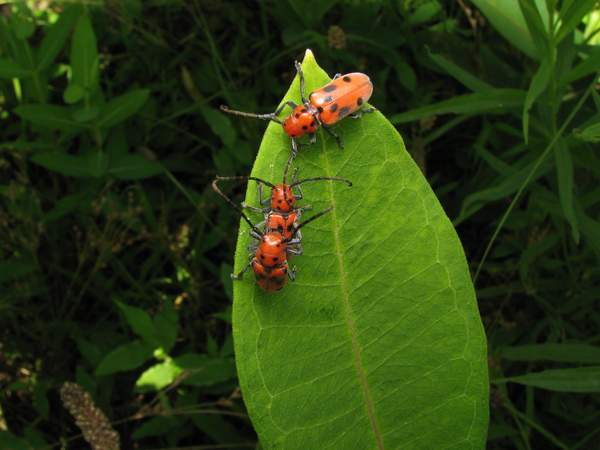
Red milkweed beetle (Tetraopes tetrophthalmus)
feeds on common milkweed
Moving on to other dependents we find beetles. We are most familiar with the milkweed longhorned beetle, often found on common milkweed. If we translate the scientific name of the most familiar one, Tetraopes tetrophthalmus, we would call it the four-eyed four-eyes, although it is known as the red milkweed beetle. The peculiar eyes of all the Tetraopes beetles are divided by the base of the antennae, hence the name. But it gets more complicated because instead of just one species there are at least 14 related and similarly looking species of four-eyed milkweed beetles. Each species sticks to only one or at most two species of milkweed. For instance, the red milkweed beetle feeds only on common milkweed, the red-femured milkweed borer on showy milkweed, and the blackened milkweed beetle on swamp milkweed.

The list goes on and on. It includes beetles of several families. For the sake of briefness see images of a few of them.

Swamp milkweed beetle larva (Labidomera clivicolis)
feeding on milkweed


Dogbane beetle. Larva feeds on dogbane or milkweed

Milkweed stem weevil (Rhyssomatus lineaticollis)
Larvae of several species feed on milkweeds

Small milkweed bug (Ligaeus kalmii)
Large milkweed bugs (Oncopeltus fasciatus)

Let us take a look at the milkweed bugs. The most familiar ones are the large milkweed bug (Oncopeltus fasciatus) and the small milkweed bug (Lygaeus kalmii). Curiously, despite their names, they are not entirely dependent on milkweed. They have been seen feeding on other plants, and even on other insects, in the case of the small milkweed bug.

Milkweed aphid (Myzocallis asclepiadis)
feeding on common milkweed

Several kinds of aphids attack milkweeds. Two of them are dependent on common milkweed. They are Aphis asclepiadis, and Myzocallis asclepiadis; no common name for these either.

All these and many more feed on milkweeds, some on only one species, others on several or many.

When we nurture monarch butterflies by planting milkweeds we are doing more than aiding the butterflies. We are helping the entire milkweed community or series of communities. The members of such communities or ecosystems interact with each other and, in turn, with a wide arrangement of other participants of this intricate play, such as neighboring plants and soil organisms. By preserving the habitat of monarchs, we are also preserving biodiversity. All species are important and we need to respect these communities and learn more about them.
Large milkweed bugs (Oncopeltus fasciatus)

See also:
Food Chain in the Milkweed Patch

 
References

Tuesday, November 20, 2012

Goats Put to Service at Pennypack


If you go for a walk at Pennypack Ecological Restoration Trust, you may run into some unusual workers recently enlisted to deal with weeds.

My friend and I went there for a walk last Monday and came upon four goats inside an enclosure made of electrified wires. These handsome creatures were merrily munching away brambles, multiflora roses, and oh joy, poison ivy!

Three young men wearing green shirts with the Pennypack logo were putting the final touches on the signs alerting people about the electric wires. We were full of questions for them and were pleased to see them eager to talk.

They told us that restoration programs have started using goats to control invasive vegetation, particularly in the West, and also in Staten Island, New York. Sometimes goats are more effective and more economic than herbicides or weed-whacking. Thus, these fellows convinced the director to start a goat program at Pennypack.

The four goats arrived last Easter and were put to work a month later, after a period of acclimation. Until now they had been doing their weeding job in secluded areas out of sight of visitors. This was their first day in a more visible place by the main trail. It is the visitors' turn to get habituated to the goats and to begin to appreciate their restoration services.

Before and after. November 12, 2012
Before and after. November 16, 2012
Everyday, these eager workers are brought to a patch in need of clearing and left there until dark. They may have to return to the same spot the next day if they haven't finished the job. After that, they are gradually moved to other patches. The goats spend the night in a roofed shelter safe from coyotes. Did you know that there were coyotes in Pennypack? Now you do.

I returned four days later to inspect the progress. The enclosure had been moved a short distance from that of the first day. The happy animals seemed to never stop chomping away at brambles and vines. At first, it wasn't easy to tell what they had accomplished; but after I found my bearings I could see that, in fact, they had disposed of a significant amount of tangled vegetation. They had also munched on the bark of some tree branches. They are not to blame for being so indiscriminate. It is the human handlers' responsibility to place them only where they can do no harm to valuable native plants.

The plan is to restore the goat-cleared areas by replanting them with native plants. This method beats using herbicides. It also beats using human workers, especially when poison ivy is abundant or when the mats of vegetation are impenetrable. Bear in mind that goats may cause damage to valuable plants if given the opportunity; so precautions are needed.

I will continue checking periodically on these four legged employees of Pennypack.

Invasive vines waiting to be disposed of by goats
Beatriz Moisset.11/17/2012
© Beatriz Moisset. 2012

Tuesday, May 22, 2012

No Tree is an Island

The small seed fell on the fertile soil. After a rest period it swelled and burst out of its case. It lifted its head and began to grow, enjoying the sunshine and the rain water that penetrated the ground and bathed its small roots. After a number of years, it became a significant member of the forest, as large as some of its companions. It had become a tree. And that is what we will call it from now on: Tree.

Tree follows an annual routine, each spring it covers itself with flowers, the agents of a special contract with insect partners. It lures these partners with the perfumed and brightly colored flowers. Tree provides them with nectar and pollen and makes use of them to have its pollen carried to other members of its species. The tiny partners are unaware of the pollination service they provide. Tree uses them for its own purposes, to ensure the next generation and pays them handsomely.

Once the flowers are pollinated, fruits grow, with seeds inside that will complete the process of starting another generation. When the seeds are ready, Tree resorts to other kind of attractants to call a second set of partners. The fruits ripen, become sweet and nutritious and their colors turn bright inviting birds and maybe squirrels or other small creatures as well as larger ones. Tree provides them with sugars and vitamins, to induce them to carry the seeds some distance, so Tree's descendants can spread far and wide.

Tree has relationships with many other members of the forest. Some are not so friendly; they can even be costly.  Tree resorts to other items in its tool kit, including weapons and even hiring some allies of a different sort. Multiple creatures feed on the leaves and other tissues of Tree. Most of the time they don't cause serious damage because Tree uses its defenses to be unpalatable, thus repelling a good number of them or limiting how much they can eat. If things get out of hand Tree resorts to another defense: it calls helpers, parasitic wasps, ready to lay their eggs on the damaging insects, thus bringing down their populations and the damage that they might inflict on Tree otherwise. If that defense isn't enough, Tree can count with the help of several other enemies of its enemies, ladybugs, lacewings and a few others. Tree doesn't know it, but even its enemies may provide it some benefits. Some of them end up feeding the very birds that at other times take care of dispersing Tree's seeds. So, it would be more appropriate to regard them as taxes, that necessary evil, rather than enemies.

Thus, Tree is intertwined to the life of the forest in multiple ways above ground. It is time that we take a look below ground, where the web of life is just as intricate or even more so.

There are certain fungi, called mycorrhizae, that partner with Tree in an intimate way. They are composed of very thin threads similar to rootlets but thinner and far more abundant. They form an endless mesh wrapping around Tree's roots and even penetrating them. They are not a threat but helpers. They dramatically increase the reach of Tree's rootlets and they are far superior at extracting water and essential minerals from the soil.

They render some of these to Tree which, in return, pays its partner with nutrients produced by its leaves. Not satisfied with that, mycorrhizae reach out to other trees and plants, providing similar services. The remarkable thing is that they have the faculty of carrying nutrients from one plant to another when a particular one is under stress and the others are doing well. Thus, the partnership goes well beyond Tree to the entire community.

Mycorrhizal interconnections don't stop there. They also interact with a variety of soil bacteria. These bacteria, too, are very good at producing an assortment of chemicals, some of them useful to the mycorrhizae and also to Tree.

When mycorrhizae want to reproduce, they form the familiar mushrooms often seen on the forest floor. Other mycorrhizae produce truffles instead. Now, it is time for another partner to enter the scene. The mushroom or truffle is nutritious to many forest creatures, beetles, squirrels, flying squirrels. They seek the mushroom or truffle's flesh, swallowing some spores along with it. Later on, they pass the spores at some distance, where new mycorrhizae can grow away from the parent and develop a relationship with other plants.

Tree sheds its leaves every year. These would accumulate to the point of smothering the soil if it wasn't for the work of other helpers. A wide array of insects, fungi, bacteria, nematodes slowly chews away all this matter. It takes them years to return all the nutrients to the soil but they accomplish this task.

I probably left out many other partners of Tree. But this could suffice for now. We can firmly conclude that no tree is an island. No other creature is an island either, all joined together in the Web of Life.


© Beatriz Moisset. 2012

Thursday, March 08, 2012

Mycorrhizae and the web of life

A squirrel feeding on mushroom

The role of mycorrhizae in the garden

Mycorrhizae, the symbiotic fungi that feed on organic matter from green plants and, in return, supplies them with water and minerals, is an essential part of an ecosystem. More than 80% of all land plants depend to some extent on mycorrhizae.

In turn, mycorrhizae need the help of some animals to spread the spores. The squirrel is one of these friends of mycorrhizae. By eating mushrooms, the fruiting bodies of mycorrhizae, they take in spores and pass them through their intestines, depositing them later on far from the mother fungus.

A mycorrhizal mushroom

There are opportunists that take advantage of others, in nature as well as in human society. Some green plants have lost their chlorophyll; so they obtain their food from others. This is the case of Indian pipe, a small whitish plant growing among the leaf litter. The above ground part of the plant is just a stem with a few highly reduced and useless leaves and a flower that bends down resembling a pipe, hence the name. Indian pipe's roots extract nutrients from the mycelium of fungi, most commonly mycorrhizal fungi. They, indirectly parasitize the trees that nourish the mycorrhizae.

Indian pipe, a parasitic plant

Root Partners. Mycorrhizae

List of articles

© Beatriz Moisset. 2012

Monday, January 09, 2012

Root Partners, Mycorrhizae


The remarkable partnership between plant roots and fungi called mycorrhizae is worth studying. A mushroom is a lot more than a mere addition to the forest floor. Learn more about mycorrhizae


Mycorrhizae, 1
Mycorrhizae, 2 

© Beatriz Moisset. 2012

Sunday, August 14, 2011

Utilities right-of-way. Native plants

Horsham Trail. Utilities right-of-way. Too much lawn, perhaps

Why don’t we turn all the utilities right-of-way lands into oases for wildlife? Am I a dreamer? I hope not. Near my home, a several miles long trail runs under high-voltage wires. When I walk there I see joggers and bikers, mothers pushing baby carriages, and walkers, just like me. The surroundings are pleasant, just a tad artificial, not quite a nature area; although closer to a nature area than busy noisy streets.

A corn field next to the utilities right-of-way
Horsham Trail

How much work and investment would it take to turn such areas into natural or semi-natural ecosystems? Perhaps, with careful planning, they would be easier and cheaper to maintain if they were allowed to become more natural.


Restored native grasses at Pennypack Restoration Trust
An example of what can be done

For instance, most of the lawns near the trail could be turned into wildflower meadows. The lawn closer to the trails could be allowed to support many broad leaved plants; accepting them as grass companions rather than treating them as weeds. It would be helpful to replace the non-native trees already planted with native ones, which are considerably better at supporting wildlife.


"Unkempt" lawn with wildflowers which attract butterflies.
Horsham trail


Some of these measures may be expensive at first but, ultimately, they would save money and upkeep time because native vegetation has evolved in that particular kind of soil and climate and is best suited for it. It also has co-evolved with the other members of the community. Native plants support more wildlife, including butterflies and birds, thus beautifying the land, in addition to improving the ecological balance. All and all it is a win-win situation.

List of articles

Sunday, July 24, 2011

Wildlife Food and Non-native Plants

Queen Anne's lace and many visitors. What is it replacing?

I worry sometimes when people insist on seeing the merits of some introduced plant and claim that it is good for wildlife. We are all familiar with butterfly bush attracting butterflies and with the berries and rose hips of several alien plants which feed the birds. I have also seen Queen Anne’s lace blossoms covered with flower visitors. Another example is this blog article about English ivy and pollinators: Pollinators aplenty: English Ivy mixed blessings. The author tells us that the English ivy in his property is attracting numerous pollinators at a time when there aren’t any native flowers. He suggests that we “should step back and view non-natives with less disdain until we understand better what roles they now play in their adopted habitats.”

I think that this philosophy shows a lack of understanding of ecosystems and of what is missing in those that have been altered by humans. We tend to think that habitat loss is something far away, clear-cutting in the Amazon, for instance. We seem to forget that the urbanization and suburbanization of the areas where most of us live are representatives of a huge amount of habitat loss.

When pollinators and birds resort to non-native flowers and berries, it is because the habitat has been severely disturbed and the native plants that were supposed to sustain them are lacking. A healthy habitat is an assemblage of co-evolved and synchronized plants and the wildlife that feed on them. The absence of such plants is a very sad indication that the ecosystem has been dramatically disrupted.

Calling non-native plants beneficial to wildlife is ludicrous. They are merely acting as prosthesis. If I had a leg amputated, I too would sing the praises of a high quality prosthesis, no matter how alien to my body it was. But, I would prefer my own, native and co-evolved with my body, original leg.

Butterfly bush provides nectar to butterflies but very little else, unlike many native plants
Let us not be seduced by the fact that some introduced plants are used by wildlife. Normally, the natives do that job a lot better, plus they provide countless other services to the ecosystem. We are barely beginning to understand the very complex interactions between all the members of a living community. It is becoming apparent that most of them are missing when we mix organisms from all sorts of places.

More on the subject: I do not hate invasive species

List of articles