Showing posts with label pollination. Show all posts

Tuesday, May 22, 2012

No Tree is an Island

The small seed fell on the fertile soil. After a rest period it swelled and burst out of its case. It lifted its head and began to grow, enjoying the sunshine and the rain water that penetrated the ground and bathed its small roots. After a number of years, it became a significant member of the forest, as large as some of its companions. It had become a tree. And that is what we will call it from now on: Tree.

Tree follows an annual routine, each spring it covers itself with flowers, the agents of a special contract with insect partners. It lures these partners with the perfumed and brightly colored flowers. Tree provides them with nectar and pollen and makes use of them to have its pollen carried to other members of its species. The tiny partners are unaware of the pollination service they provide. Tree uses them for its own purposes, to ensure the next generation and pays them handsomely.

Once the flowers are pollinated, fruits grow, with seeds inside that will complete the process of starting another generation. When the seeds are ready, Tree resorts to other kind of attractants to call a second set of partners. The fruits ripen, become sweet and nutritious and their colors turn bright inviting birds and maybe squirrels or other small creatures as well as larger ones. Tree provides them with sugars and vitamins, to induce them to carry the seeds some distance, so Tree's descendants can spread far and wide.

Tree has relationships with many other members of the forest. Some are not so friendly; they can even be costly.  Tree resorts to other items in its tool kit, including weapons and even hiring some allies of a different sort. Multiple creatures feed on the leaves and other tissues of Tree. Most of the time they don't cause serious damage because Tree uses its defenses to be unpalatable, thus repelling a good number of them or limiting how much they can eat. If things get out of hand Tree resorts to another defense: it calls helpers, parasitic wasps, ready to lay their eggs on the damaging insects, thus bringing down their populations and the damage that they might inflict on Tree otherwise. If that defense isn't enough, Tree can count with the help of several other enemies of its enemies, ladybugs, lacewings and a few others. Tree doesn't know it, but even its enemies may provide it some benefits. Some of them end up feeding the very birds that at other times take care of dispersing Tree's seeds. So, it would be more appropriate to regard them as taxes, that necessary evil, rather than enemies.

Thus, Tree is intertwined to the life of the forest in multiple ways above ground. It is time that we take a look below ground, where the web of life is just as intricate or even more so.

There are certain fungi, called mycorrhizae, that partner with Tree in an intimate way. They are composed of very thin threads similar to rootlets but thinner and far more abundant. They form an endless mesh wrapping around Tree's roots and even penetrating them. They are not a threat but helpers. They dramatically increase the reach of Tree's rootlets and they are far superior at extracting water and essential minerals from the soil.

They render some of these to Tree which, in return, pays its partner with nutrients produced by its leaves. Not satisfied with that, mycorrhizae reach out to other trees and plants, providing similar services. The remarkable thing is that they have the faculty of carrying nutrients from one plant to another when a particular one is under stress and the others are doing well. Thus, the partnership goes well beyond Tree to the entire community.

Mycorrhizal interconnections don't stop there. They also interact with a variety of soil bacteria. These bacteria, too, are very good at producing an assortment of chemicals, some of them useful to the mycorrhizae and also to Tree.

When mycorrhizae want to reproduce, they form the familiar mushrooms often seen on the forest floor. Other mycorrhizae produce truffles instead. Now, it is time for another partner to enter the scene. The mushroom or truffle is nutritious to many forest creatures, beetles, squirrels, flying squirrels. They seek the mushroom or truffle's flesh, swallowing some spores along with it. Later on, they pass the spores at some distance, where new mycorrhizae can grow away from the parent and develop a relationship with other plants.

Tree sheds its leaves every year. These would accumulate to the point of smothering the soil if it wasn't for the work of other helpers. A wide array of insects, fungi, bacteria, nematodes slowly chews away all this matter. It takes them years to return all the nutrients to the soil but they accomplish this task.

I probably left out many other partners of Tree. But this could suffice for now. We can firmly conclude that no tree is an island. No other creature is an island either, all joined together in the Web of Life.


© Beatriz Moisset. 2012

Friday, April 22, 2011

How much is a bat worth?

Who would think of putting a dollar value on a bat? Well, it turns out that some researchers have done just that. I am not talking about a baseball bat but about that creature of the night so loathed by some. We tend to associate bats with witches and demons rather than with crops.

Is there a reason for putting an economic value on a bat? The answer is: Yes. Bats feed on flying insects at night. Many of those insects are pests that damage our valuable crops. So it turns out that bats are valuable to farmers.

A group of scientists have been trying to estimate the numbers of insects bats eat and the possible impact on agriculture and forestry if bats stopped supplying this pest control. They published their conclusions in the scientific journal, Science. Through a number of complex calculations of pesticide application and crop losses they came up with a range between $3.7 billion and $53 billion a year in the United States alone. It is not possible to be more precise when considering so many variables. Anyway the numbers are impressive.

It is worth mentioning that these maligned creatures have other functions in addition to the pest control discussed in this study. They are pollinators of many night blooming flowers. Cacti, in particular, are dependent on bats for pollination. Many cacti of the West synchronize their blooming time with the migration of some species of bats. Try to imagine what the West would be like without cacti. Another service, especially in the tropics is seed dispersal. Bats eat the fruits of many trees, such as fig trees and pass the seeds far from the mother trees.

Unfortunately, in recent times, bats are encountering serious problems. There is one disease in particular that is decimating the populations of bats in the United States. This fungal disease, called "white nose syndrome", weakens and kills large number of bats, especially during the winter. Not much is known about this illness, nor there is a cure in sight yet. It is for this reason that the researchers decided to investigate how the loss of bats would affect agriculture. Even lacking more accurate numbers the results are alarming; the losses to crops and forestry could be very serious.

The web of life is very intricate and often we don’t know enough about all the threads that make this tapestry. This is another example of a creature whose value we fail to recognize. It took a threat to the welfare of bats, such as the white nose syndrome for the world to stand up and take notice. We are only now beginning to appreciate the value of the free services provided by these creatures: pollination, seed dispersal and pest control. We have to look at bats with renewed respect. Let us develop a kinder attitude towards our friends, the bats.

List of articles

Friday, February 05, 2010

List of articles

Pollinators
Alfalfa Pollination
Ants, the Unlikely Pollinators
Bees and Vitamins
Bees in the Garden
Beguinners Guide to Pollinators
Blowflies are Pollinators Too
Bumble Bees and Odor Pollution
Bumble Bees and Turtleheads
A Busy Pollinator and a Relaxed One
Buzz Pollination of Fabaceae Flowers
Crab Spiders Hiding in Goldenrod
Don't Underestimate the Native Pollinators
Flower Flies, the Great Impersonators
Flower Longhorn Beetles, the Elegant Crowd 
Globetrotting Butterflies
More Globetrotting Butterflies
Globetrotting Skippers
Hairy-legged Fly, a Gardener's Friend
Importance of Native Pollinator
Magnolias and Beetle Pollination
The Mason Wasp and the Caterpillar
Metallic Green Bees 
Monarch Butterfly, a Case of Mistaken Identity
Monarchs and their Enemies
The Midge and the Chocolate Lover
My Bees and Climate Change
Native Bees, Honey Bees and Natural Areas
Of Bees and Honey. What is Honey for?
One Bite out of Three
One Bite out of Three and Wildlife
One Bite out of Three Before Columbus
Our Friend the Elephant Mosquito
Partners and Robbers
The Pure Magnificent Green Bee
Pollinator Gardens Do Double Duty
Pollinators in Winter
Pollinators of Official State Flowers
Pollinators of the American Chestnut
Pollinators, the Night Shift
Pollinators of the Pine Barrens, NJ
Roadside Pollinator Gardens and Traffic
Robbers and Thieves 
A Sea of Blue Flowers
Sneezeweed or Helenium
Sticky Pollen 
Symetry
Syrphus Fly, a Pollinator and Aphid Eater
The "Unbeetle" Beetle
Thrifty flowers
What is the Connection between Honey Bees and Almond Farming?
What is the Connection, II. Corn
You can Help Pollinators in your Own Garden

Moths as Pollinators
Black-and-yellow Lichen Moth, a Little Known Pollinator
Crambid Snout Moths
Gardening for Honorary Butterflies: Mint Moths
Hummingbird Moths. Where do They go in Winter?
Inch Worms: More Little Known Pollinators
Little Known Moth Pollinators: Seed Casebearers and Flower Moths
Metalmark Moths. More Little Known Pollinators
Noctuids, Another Family of Little Known Pollinators
Plume Moths. More Little Known Pollinators
Pollinators, the Night Shift
Yellow-collared Scape Moth
The Yucca Moth and the Yucca
Zygaenidae, More Little Known Pollinators 

Bee Houses
Bees in the Garden
Pollinators in Winter

Gardening
Don't Kill Your Friends
Food for Wildlife
Ladybugs, Praying Mantis and Other So-called Beneficials. Are They?
Lawns for Pollinators, Grass Companions
Lawn for Pollinators. Part II
Lawn for Pollinators. Part III
In Praise of Bare Spots in the Garden
Pollinator Gardens and More
Pollinator Gardens Do Double Duty
Utilities Right of Way, Native Plants
You can Help Pollinators in your Own Garden

Pollinators in Winter
Globetrotting Butterflies
More Globetrotting Butterflies
Globetrotting Skippers
Wintering Pollinators
Pollinators in Winter. Fritillaries
Hummingbird Moths. Where do they go in Winter?

Flowers, their strategies
The Life of a Flower
Bumblebees and Turtleheads
Deceitful Flowers. Lady Slipper
Only Friends Welcome Here
Maple Flowers
Flowers Schedule
Inkberry Pollination
Jack-in-the-pulpit and its Cruel Deception
Nectar: Breakfast of Champions
Nectar: Drink with a Zing?
Where Have all the Spring Beauties Gone?

Biological Interactions
Alien Invasions
The Birds and the Bees. The True Story
Bugs in the Garden. Hornworm: Friend or Foe? Friend and Foe
Food Chain in the Milkweed Patch
Goats put to Service at Pennypack
Goldenrods and their Dependent Fauna
Goldenrods Fabulous Fauna
Goldenrod Galls and their Fauna
Goldenrod Galls, the Long Stemmed Ones
Hidden Life on a Pear Tree
How Much is a Bat Worth?
Introduced Species Develop Unexpected Relationships
Invisible Bird Food in the Foliage
Ladybugs, Praying Mantis and Other So-called Beneficials. Are They?
The Living Constellations Beneath our Feet
Mile-a-minute
Milkweed's Last Hooray
Milkweed's Last Hooray. Part II
Milkweeds, Monarchs and More: The Milkweed Community 
The Monarch's Breadbasket
Squirrels, Managers of the Forest
Stinging Nettle. Food for Butterflies and Food for Us
The Hornet's Nest
Turtles, Shorebirds and Us
Viburnum leaf beetle, an introduced pest
When did "Common Milkweed" Become Common?
Wildlife Food and Non-native Plants
The Year the Bears went Hungry

Birds
Caterpillars are for the Birds
Feed the Birds
Invisible Bird Food in the Foliage
“Locavore” Birds. Grow your own Birdseed
A River of Birds

Nature
Funny Larvae
Hidden Life on a Pear Tree 
Plastics are not Part of the Web of Life 
Pollinators: Too Much Light!
The Sounds of Nature
Utilities Right of Way. Native Plants
Wasps, Motherhood and Ultrasound

Biocontrols
Bugs in the Garden. Hornworm: Friend or Foe? Friend and Foe
Goats Put to Work at Pennypack
How Much is a Bat Worth?
Mile-a-Minute
Ladybugs, Praying Mantis and Other So-called Beneficials. Are They?
Pollinator Gardens Do Double Duty
Syrphus Fly, a Pollinator and Aphid Eater
The Prolific Aphids
The Hornet's Nest

Defenses against enemies
A Butterfly´s flashy colors
Bees and stingers

Little stories
A Night in the Life of a Working Mother
Floral Emissaries
For the Love of Flowers
The Dancing Grasses
Dancing in the Valley of the Lilies
Official State Insects
The Poop Bug and the Golden Beetle
The Year the Bears Went Hungry
Ladybeetles, the Good Ones and the not so Good

Monday, October 05, 2009

The Midge and the Chocolate Lover

What does a midge have to do with chocolate? More than you think. Chocolate comes from cocoa trees that grow in the tropics. These trees look quite different from most other plants. Instead of having flowers in the most conspicuous places, they have them on the trunk and lowest branches. These flowers are small and white and face down, the reason for all this is that they attract tiny flies, known as midges, rather than bees or other better known pollinators. The midges are ordinarily attracted to fungus and cocoa flowers smell somewhat mushroomy, too. In essence, for the cocoa tree to bear fruit, first it has to be pollinated by midges.
Think about it next time you eat a bite of that marvelous thing known as chocolate.

List of articles

Thursday, October 01, 2009

Syrphus fly, a pollinator and aphid eater

Syrphus fly on Queen Anne's lace. © Beatriz Moisset. 2009
Among the many flower flies there are some that are beneficial to the garden in more ways than one. Flies of the genus Syrphus and also some of their relatives are moderately good pollinators when compared to bees. They visit flowers frequently because they need nectar to fuel their flight; the females also need protein rich pollen for their eggs to grow and mature. The reason why they are not as good as bees is that their bodies have very little hair so pollen doesn’t adhere very well to them. However what they lack in efficiency they make up in sheer numbers. In some instances flies are more abundant than bees and may end up providing a better service to some flowers.

The genus Syrphus counts with several species in North America. They are very hard to tell apart; as a matter of fact they are also hard to differentiate from their close relatives: Eupeodes. Entomologists need to examine them under the microscope and look for minute details of wings and other body parts to identify each species.

Beginners have an even harder time and frequently confuse them with bees, although their single pair of wings should be a clue that they are flies not bees. They are considerably smaller than honey bees but there are many species of native bees about the same size as Syrphus. There are other ways of telling these flies apart from bees; their antennae are very short and with a funny shape with a little appendage called an arista; their eyes are enormous and their legs skinnier than those of bees. As I mentioned before they are nearly hairless. Although they may look like bees you don’t need to fear their sting because they have none.

Larva feeding on aphids on a milkweed's leaf. © Beatriz Moisset. 2009
What is interesting about these flies is that in addition to being pollinators they are very helpful to your garden as larvae because they eat aphids. The female lays her eggs near an aphid colony. The tiny maggots that emerge from the eggs are blind and legless but they don’t seem to need those organs to find their food.

They promptly go to work helping themselves from the colony. It is odd to see some completely unconcerned aphids near a maggot devouring one of its sisters; they may even come close to inspect it. Each maggot needs a large numbers of aphids and about a couple of weeks to complete its growth. It finds a place to pupate, under a leaf or on the ground and emerges in a few days ready to start raising another family of pollinators/aphid eaters. Gardeners familiar with these qualities of Syrphus flies strive to grow the plants that will provide pollen and nectar to them to ensure that they do their duty as aphid patrol.

List of Articles

Guide to Pollinators and Other Flower Visitors

© Beatriz Moisset. 2009

Monday, September 07, 2009

The year the bears went hungry


Do you remember the children's book: Blueberries for Sal? Sally, a little girl, went blueberry picking with her mother every year. One day the two humans had a close encounter with a mother bear and her cub who were feeding on berries in the same blueberry hill. Both bears and humans decided to leave each other alone and continued their activities in opposite sides of the same hill. The thrill of this encounter remained firmly embedded in the minds of Sal and her mother.

What the book didn't tell you is that a few years later Sal and her mother went blueberry picking as it was their habit and suffered a big disappointment when they found no blueberries. The plants looked very healthy but almost totally lacking in fruit. So they went to the store where they bought berries for their traditional annual jam.

The mother bear and her new cub went also blueberry picking as they did every year and their disappointment was bigger than that of the humans. To them the juicy fruits were vital and they could not resort to a grocery store. That winter they went to sleep very hungry and it is not known whether they survived that tough season after such deprivation.

What Sal and her mother didn't know and what the bears had no way to know was that there had been a severe infestation of the nearby spruce forest. The caterpillars of a moth had reached enormous numbers and were defoliating the forest. To combat such a pest the foresters had sprayed a powerful insecticide, not realizing the further consequences of this action.

Blueberries need to be pollinated by very diligent bees, not necessarily honey bees, but a wide array of native bees, in particular the so called blueberry bee. Many of these bees nest near the trees that had been sprayed to combat the spruce worm. This brought tragedy to the little bees. They were poisoned just as effectively as the spruce worm and died by the millions. As a consequence nobody pollinated the blueberry flowers and the shrubs produced no fruits.

When blueberry growers in the area realized what had happened, they rose up in arms. They finally succeeded in putting an end to the pesticide use. However, it took several years for the bee populations to recover and as a consequence blueberry bushes, as well as a number of other plants in the area, produced very limited amounts of fruits and seeds. Not only bears suffered the scarcity of berries, but also a number of wild creatures of the forest that also depend on such food, such as birds. It is quite possible that many of them died of hunger.

Let us hope that the health of the forests and surrounding fields was eventually restored, so that Sal, her children and grandchildren can go on enjoying this marvelous web of nature made of blueberries and bees and of birds and bears.

List of articles

Tuesday, August 25, 2009

The Hornet's Nest

The fallen 12" wide hornet's nest showing some of its internal structure
A friend gave me a large hornet's paper nest the other day. She had found it last summer when she got stung while mowing her lawn. The nest was up on a tree, hanging from a high branch. After that she was weary of approaching the general area but did nothing to remove the nest and didn't suffer any further attacks. When Fall came, a strong wind broke the branch and brought down the paper nest already abandoned by its inhabitants.

When she gave me the nest, she asked me a few questions while we both marveled at its craftsmanship. There are several species of wasps referred to as hornets. They build paper nests up on trees using chewed pieces of vegetable material that hardens and becomes the consistency of paper.

The nest's envelope and cells are paper made of wood fibers mixed with wasp's saliva and applied in layers. The different colors show the variety of sources used in the construction
This is what Bugguide has to say about the life cycle of this particular kind of hornets: "A fertilized queen overwinters and starts a paper enclosed nest in the Spring. As the colony grows, multiple tiers are added, consisting of hexagonal cells. Males appear in the Fall." The Texas Agricultural Extension adds this information. And you can find a few more facts in the Fairfax County Public Schools website.

Hornet's stings can be very painful and they are more likely to attack when you happen to be close to their nests; that is where the expressions "mad as a hornet" and "hornet's nest" come from. Also, they can make nuisances of themselves, especially in the fall when they boldly approach any food available at picnics. Most people don't want to know anything beyond that; hornets are to be feared and avoided. An exterminator is the first thing that they think of when finding a nest in their properties.

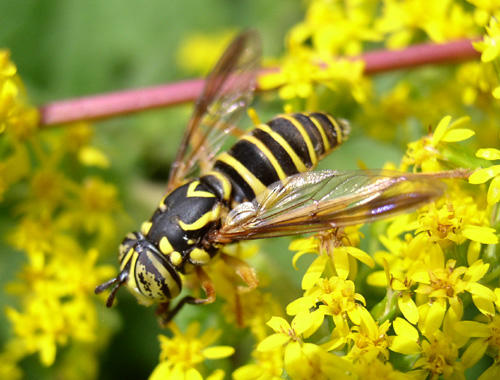
Yellowjacket on Queen Anne's lace
But, there is another side to the story, worth examining. Hornets are omnivorous eaters whose diet seems to know no limits, but it can be grouped in two types: food for the adults, mostly sugary materials to fuel their flight, and food for the growing babies, rich in proteins needed for building new tissues. They obtain the sweet materials from a variety of sources, from flower nectar to spilled soda on a picnic table; but mostly from the first. Thus, in their frequent visits to flowers they carry pollen from flower to flower and accomplish pollination. Although not as efficient as bees they deserve recognition for their job as pollinators. When it comes to feeding their babies, their diet is just as varied as the sugary one, ranging from living insects to cooked meat; from flies to bacon and hard boiled eggs. But, ordinarily, the main source of the baby food is insects that they catch in large numbers. They pounce on their prey, chew on it turning it into a pulp and feed this mush to the growing larvae in the colony.

An adult resident hornet. This one can't sting because it is a male
I would like to think that they specialize on harmful insects and leave beneficial ones alone; but, of course, this isn't true. They are equal opportunity predators and quickly attack anything available from honey bees to flies or caterpillars; as well as taking advantage of any dead meat available, be it a dead mouse or table scraps. However it seems that the bulk of their prey is made of all sorts of flies, house flies, blow flies, robber flies, flower flies, and everything in between. Many years ago a researcher counted 227 flies caught in an hour by a relatively small colony of about 60 wasps.

Caterpillars also figure prominently in their diet; once again they attack a wide range of species from butterflies to moths. Tent caterpillars are among the undesirable pests that they prey on; they may also feed their babies on Luna moths or painted ladies.

They have other connections with the rest of the living world. Some birds, such as the red eyed vireo use paper fragments from abandoned wasps nests to insulate and decorate their nests. Finally, hornets themselves are part of the food chain, providing nutrition to a number of other creatures, birds such as fly catchers, toads, bats, raccoons, etc. They are part of the web of life, linked to the plants they pollinate, the prey species they control and the species that they nourish.

My friend was wise in letting the wasp nest follow its natural course, rather than calling an exterminator. The busy hornets took care of countless insects all through the summer.

List of Articles

© Beatriz Moisset. 2013

Thursday, June 08, 2006

Inkberry pollination


Different flowers have different strategies for pollination. It is interesting to observe them and try to elucidate the interaction between flower and insect in the case of insect pollinated flowers. The small tree or shrub, inkberry (Ilex glabra), a relative of hollies, has numerous small flowers that attract a large number and variety of insects.


The name refers to the inky dark berries

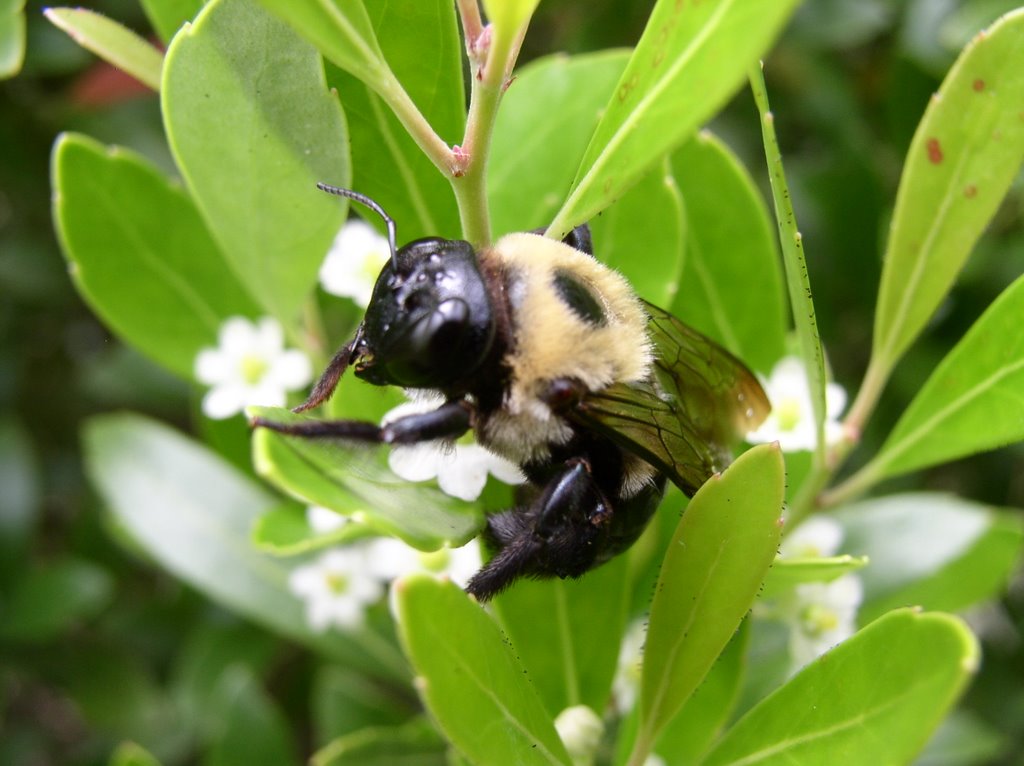
I have observed insects of at least twenty five species visiting its flowers, among them: bees and bumblebees, several kinds of wasps, flies, butterflies and moths and also some beetles. Here are a few examples:

Tuesday, April 04, 2006

Maple flowers


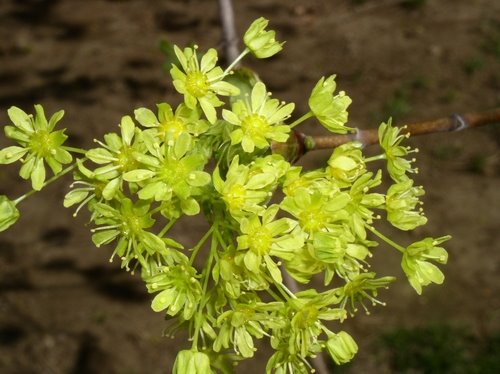
Are maples pollinated by the wind or by insects? It seem that some species use one method and some the other. Their flowers are rather insignificant, at least to our eyes, but it is possible that insects see them differently; anyways sugar maple seems to be one that receives numerous visits from hungry bees that can't find much food so early in the season. Look at the flower, it is greenish yellow, very small, although by growing in clusters, they become more conspicuous and attractive to visitors, and they have some shiny, glistening fluid on the surface, touch it with the tip of your tongue and you'll feel a very tiny taste of maple syrup. Yes, that would make them very attractive to bees.

Flowers schedule


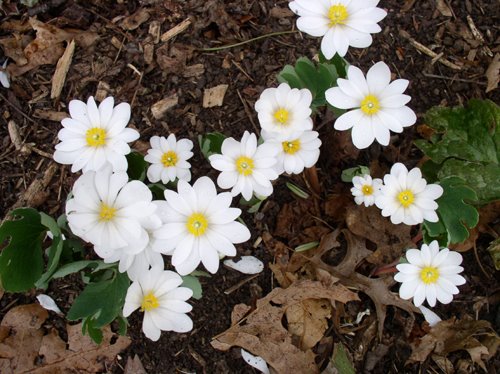
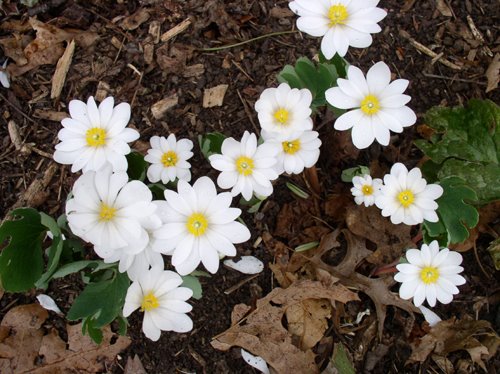
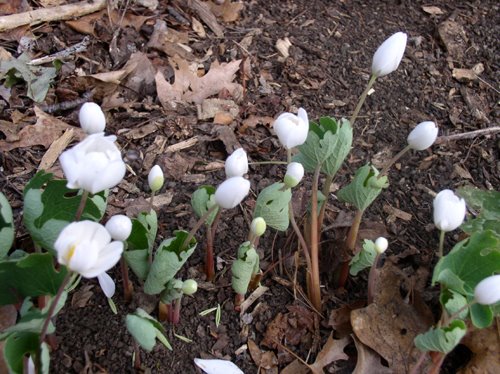
Some flowers are strongly influenced by the light and open or shut accordingly, others stay on schedule regardless of how cloudy and dark it is. This seems to be the case with bloodroot, Sanguinaria. These two pictures of the same clump of flowers were taken two hours apart, at 7:30 and 9:30 AM EST on a very cloudy day.

Sunday, February 12, 2006


Abejitas sin aguijón, Meliponinas en el hotel de Chichen Itza.

Thursday, December 22, 2005

ASCLEPIAS OR MILKWEED. Its Many Visitors

Plants of the genus Asclepias, better known as milkweeds because of its white, sticky sap, attract a huge variety of insects and other creatures. Its most famous resident is the monarch butterfly that depends on milkweeds for nutrition; but it is not the only one. Here is a small sample of the menagerie that you can find on a single plant of Asclepias.

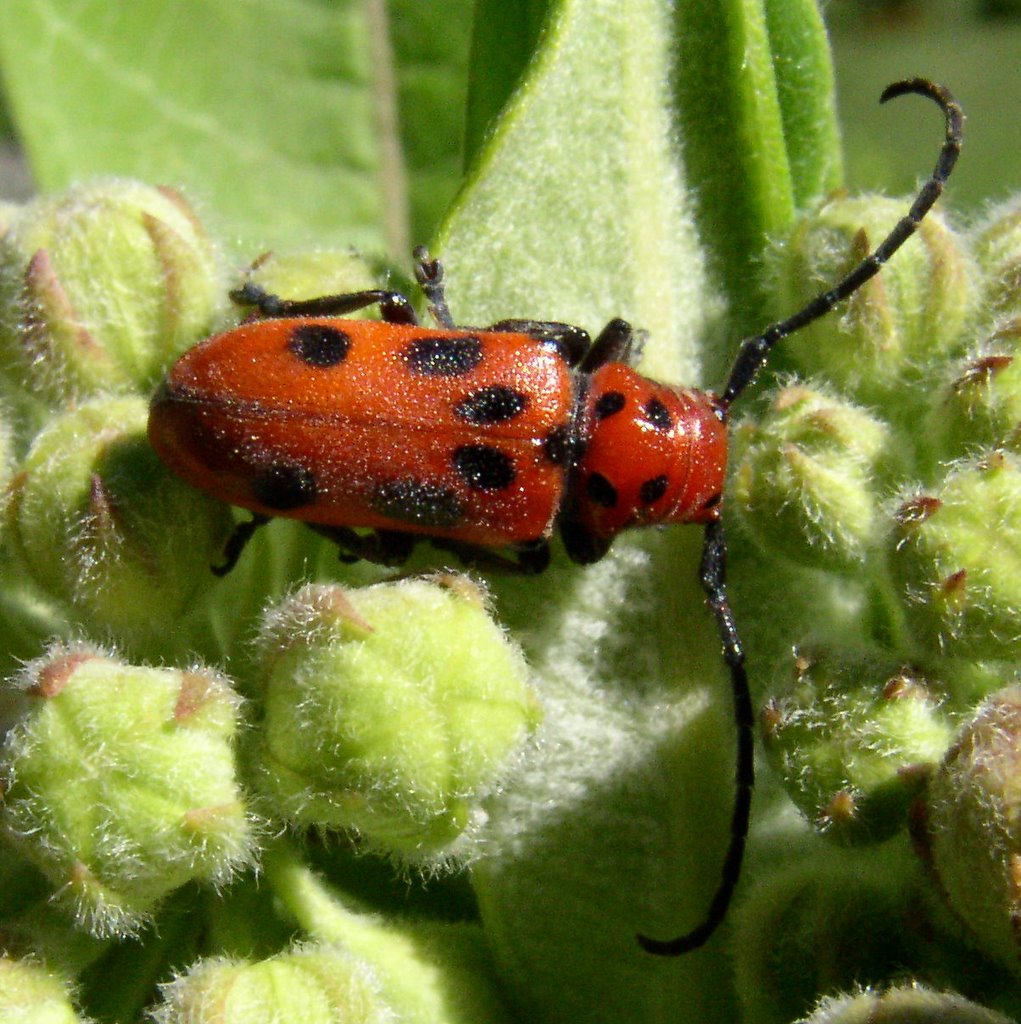
Milkweed beetle, Tetraopes tetrophthalmus (the four-eyed one)


Silver spotted skipper


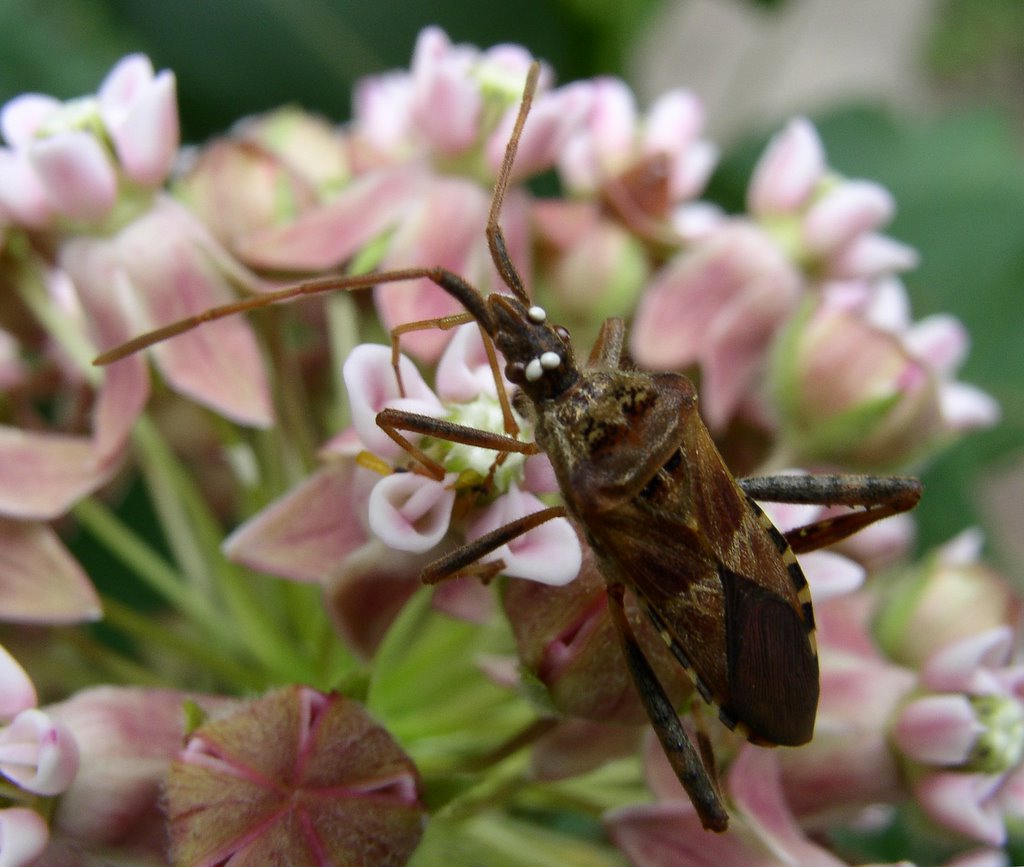
Leaf-footed bug, with eggs of a parasitic fly on top of its head


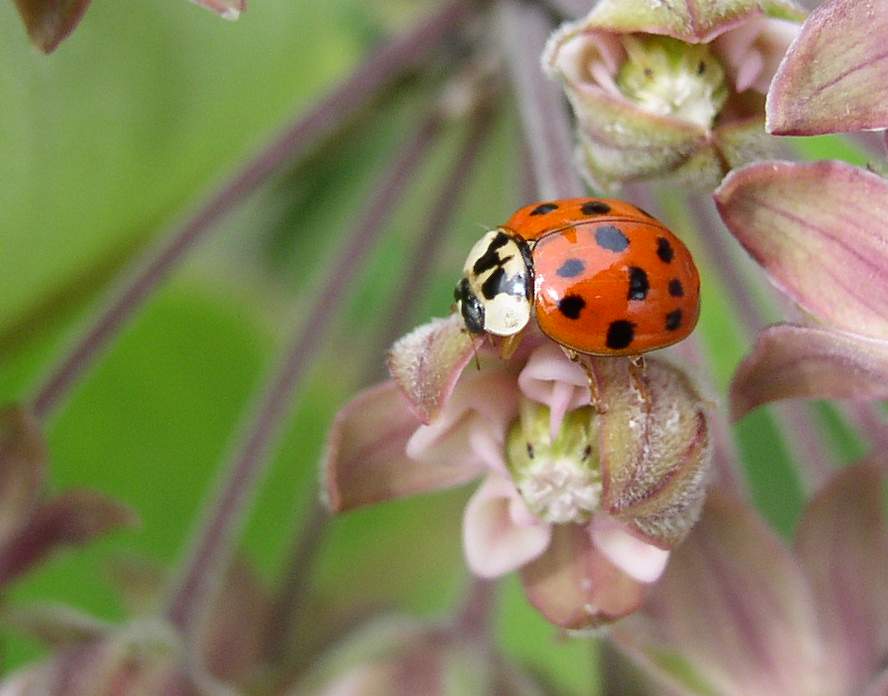
Lady bug in search of aphids.

Friday, October 07, 2005

Flower flies


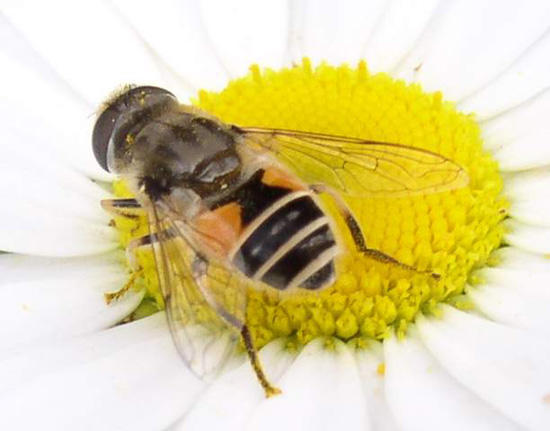
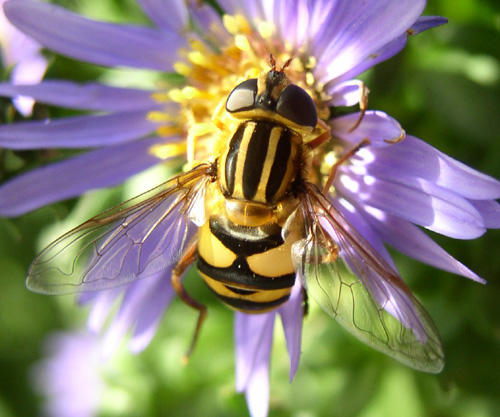
Flower flies, those tiny imitators, don’t look at all like the familiar house fly, instead they look like bees; with a disguise of yellow and black stripes.

They fool birds that avoid them for fear of being stung although they are innocuous.

Like the bees they imitate, many of them are good pollinators. Who would have thought that flies could be so pretty and so useful!


Some of them go a step further on their usefulness and eat a large number of aphids while they are larvae. Here

Sunday, September 04, 2005

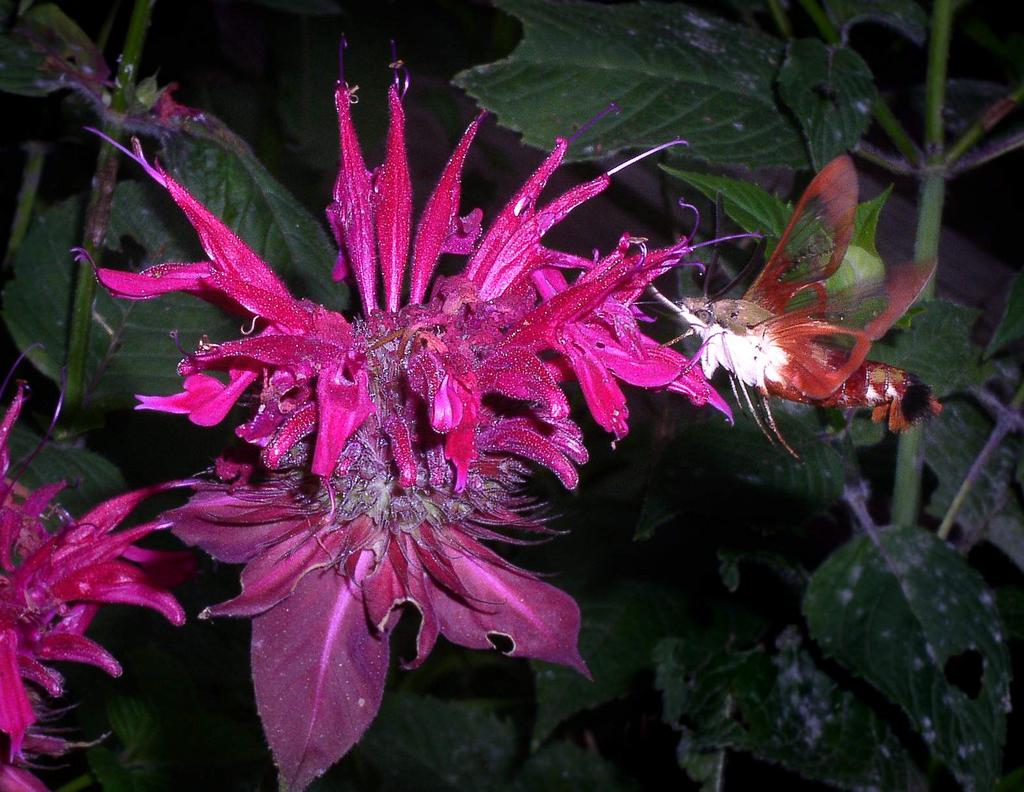
Hummingbird Moth


Don't let this little beauty fool you. It is not a tiny hummingbird, but a hawk moth. Not surprisingly it is called hummingbird moth. It is one of the few moths that are active during the day. It pollinates long throated flowers like this Monarda.