Showing posts with label web of life. Show all posts

Tuesday, August 10, 2021

Aphids, how many is too many?

                                        Microsiphum aphids on rose bush


I read somewhere (I wish I could find that reference now) that the aphid biomass in an acre of meadows can be equivalent to that of an elephant. Perhaps that is a gross exaggeration, but, even if it was comparable to the mass of a cow or a dog, that is a lot of aphids. Let us face the facts: aphids are here in our gardens in substantial numbers, whether we see them or not. I am sure that I have eaten my share of them on leaves of lettuce, and you have done so too.

Is that a bad thing? Probably not, as long as there are only a few per plant. They don’t cause serious damage and they form part of the food chain, nourishing numerous kinds of wildlife, small and large. Aphid populations can be kept in check by the combined action of all those eaters most of the time. It is a beautiful system when it works well, but sometimes it gets disrupted.

Ecologists explain repeatedly that trouble often arises when pesticides wipe out not just the aphids, but their predators. Predator populations take longer to recover, allowing newly arrived aphids to explode in numbers before balance is reestablished.

I have been looking for these aphid controls in my garden. There is a whole assortment. Usually ladybugs take most of the credit, but others are just as effective or even more so, although less visible: parasitic wasps, flower flies and lacewings, among others. Some small birds, such as nuthatches and chickadees have been seen eating aphid eggs in winter.

Syrphid fly larva feeding on aphids


Syrphid flies, also called flower flies or hover flies interest me the most because they provide another important service in the garden: they are pollinators. The adult flies spend a lot of time hovering over flowers. They land on them to feed on pollen and nectar and to meet partners and mate. Their two common names refer to these behaviors. They look very much like bees, giving rise to amusing mistakes of which I have collected a few illustrations: a book named “Bees of the World”, a business card for a shop called “The Bees Knees” and an article on bees on the French newspaper, Le Figaro. In all these cases the image is not that of a bee but of an impersonator, a fly. If you know of any other examples, please let me know, so I can add them to my list.

The larvae of some of them, those called Syrphini, feed on aphids. The females are very good at spotting incipient populations of aphids and laying their eggs nearby. When the maggots emerge from the eggs they go right to work and can dispose of dozens of aphids in the ten days or so that it takes to complete their growth.

To learn more about their life cycle I collected some, kept them well supplied with aphids and saw them grow to full size, become pupae and finally emerge as adults. I took pictures and videos of the whole thing. The videos may be gross but fascinating. A maggot blindly thrashes around until it finds an aphid, pierces its skin and proceeds to suck it dry, discarding the shriveled husk. The whole process takes only a few minutes. It resumes its search right away. No wonder they can be so good at controlling aphid populations!

Another form of trouble occurs when new species of aphids are introduced into an ecosystem. This doesn't happen intentionally, but aphids easily travel with their host plants and may be able to adapt to related plants found in their new home.


Oleander aphids on milkweed

Such is the case of the oleander aphid. It has adapted to plants of the genus Asclepias, the milkweeds, and it can wreak havoc on them. It multiplies in large numbers, free from its habitual restrains. A few species parasitize of predate on oleander aphids, such as some parasitic wasps and lacewings and ladybugs, but all them together are not enough to keep the populations of oleander aphids under control.

Friday, July 12, 2013

Milkweeds, Monarchs and More: The Milkweed Community

Monarch butterfly, adult female. It nectars on a variety of flowers
Monarch caterpillar, It feeds only on milkweeds
Monarch butterflies capture our hearts with their beauty and intrepid globe trotting. We have learned that the caterpillars need milkweeds to grow into the magnificent winged creatures. As a consequence, many gardeners gladly grow these plants in their yards and welcome the arrival of the travelers. They eagerly follow the appearance of the tiny caterpillars, their growth and final metamorphosis.

This leads many to learn more about these plants, their toxicity and the other visitors attracted by the overpowering sweet aroma of the flowers. Some gardeners don’t see them as weeds anymore but as nice additions to their butterfly gardens. Did you know that there are more than 100 species of milkweeds or Asclepias in North America? Did you know that monarchs are not the only ones that depend on milkweeds? Many other insects do. The whole story is infinitely more complex than just milkweed plant/monarch butterfly. A patch of milkweed plants is a community with many herbivores taking advantage of it, followed by carnivores, not to mention numerous pollinators.

Some of the members of this community depend exclusively on milkweeds while others benefit from these plants, but have other food choices. Pollinators and predators, fall in the second category.
Let us take a look at those that are dependent on milkweeds, those which need these plants to complete their development from egg, through immature or larval stages to adulthood. Some eat leaves; others go for stems, roots or seeds. Their tastes can be highly selective, feeding on only one or at most two species of milkweeds. Others, like the monarch butterfly, have broader tastes and accept most species of milkweeds or even some related plants. It is the growing insects that are dependent. The adults, in turn, may not need milkweeds, but they frequent these plants to lay their eggs on them.

Milkweeds have developed an assortment of defenses, such as sticky latex, hairy leaves and powerful toxins, against the cadre of hungry feeders. The eaters, in turn, have gradually found ways to overcome every one of these barriers. Milkweeds respond by producing more latex, hairier leaves, and stronger toxins. In this eternal arms race nobody wins, but nobody loses either. Like a carefully choreographed ballet, the equally matched enemies continue this dance of life and death affecting each other and in turn influencing the other members of the community.


Delicate cycnia (Cycnia tenera)
Its caterpillars feed on milkweeds
The best known, of course, is the monarch butterfly. Let us not forget its close relatives, the queen and the soldier butterflies. It is worth mentioning that a few other relatives live in South America and Africa. They are all fairly flexible and can resort to more than one species of milkweed.

Milkweed tussock moth caterpillar
feeding on common milkweed

Among the moths dependent on milkweed, the delicate cycnia (Cycnia tenera), with a very appropriate name, relies only on common milkweed and swamp milkweed. The milkweed tussock moth (Euchaetes egle) has broader tastes and can live on several species of milkweed.

Red milkweed beetle (Tetraopes tetrophthalmus)
feeds on common milkweed
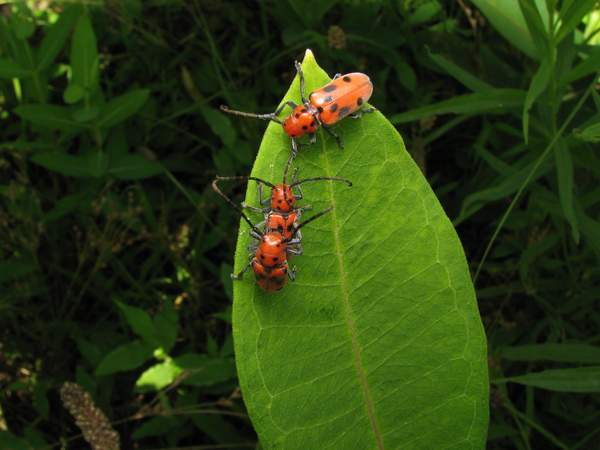
Moving on to other dependents we find beetles. We are most familiar with the milkweed longhorned beetle, often found on common milkweed. If we translate the scientific name of the most familiar one, Tetraopes tetrophthalmus, we would call it the four-eyed four-eyes, although it is known as the red milkweed beetle. The peculiar eyes of all the Tetraopes beetles are divided by the base of the antennae, hence the name. But it gets more complicated because instead of just one species there are at least 14 related and similarly looking species of four-eyed milkweed beetles. Each species sticks to only one or at most two species of milkweed. For instance, the red milkweed beetle feeds only on common milkweed, the red-femured milkweed borer on showy milkweed, and the blackened milkweed beetle on swamp milkweed.

The list goes on and on. It includes beetles of several families. For the sake of briefness see images of a few of them.

Swamp milkweed beetle larva (Labidomera clivicolis)
feeding on milkweed


Dogbane beetle. Larva feeds on dogbane or milkweed

Milkweed stem weevil (Rhyssomatus lineaticollis)
Larvae of several species feed on milkweeds

Small milkweed bug (Ligaeus kalmii)
Large milkweed bugs (Oncopeltus fasciatus)

Let us take a look at the milkweed bugs. The most familiar ones are the large milkweed bug (Oncopeltus fasciatus) and the small milkweed bug (Lygaeus kalmii). Curiously, despite their names, they are not entirely dependent on milkweed. They have been seen feeding on other plants, and even on other insects, in the case of the small milkweed bug.

Milkweed aphid (Myzocallis asclepiadis)
feeding on common milkweed

Several kinds of aphids attack milkweeds. Two of them are dependent on common milkweed. They are Aphis asclepiadis, and Myzocallis asclepiadis; no common name for these either.

All these and many more feed on milkweeds, some on only one species, others on several or many.

When we nurture monarch butterflies by planting milkweeds we are doing more than aiding the butterflies. We are helping the entire milkweed community or series of communities. The members of such communities or ecosystems interact with each other and, in turn, with a wide arrangement of other participants of this intricate play, such as neighboring plants and soil organisms. By preserving the habitat of monarchs, we are also preserving biodiversity. All species are important and we need to respect these communities and learn more about them.
Large milkweed bugs (Oncopeltus fasciatus)

See also:
Food Chain in the Milkweed Patch

 
References

Saturday, January 26, 2013

Plastics are not part of the web of life


A view of garbage.
Let me repeat this: Plastics are not part of the web of life. They do not truly recycle but downcycle. They inexorably accumulate despite the best efforts at recycling because the circle cannot be completed, so this cannot be called recycling. At best what we are doing is downcycling, modifying used plastics into lower grade plastics that can be used once or at most twice in some other form. After that, they reach the end of the line.


© DondeReciclo.org
The consequence is that plastics keep accumulating in the landscape. Horrific examples abound: dead albatrosses with stomachs full of plastic fragments; turtles and other wildlife chocked to death by plastic rings; fish full of plastic. Worse yet, the smaller fragments are out of sight, but not entirely out of the picture. Some may be inert but many others are potential carcinogens and toxins. If they are eaten by animals, they become part of the food chain. Are we eating our own plastic garbage? We probably are.

Dead albatross chick.
 What to do? We may not be able to eliminate plastics entirely. Some plastics are useful, even highly valuable and we don't have to give all of them up. But we could start with the disposable, one-use only plastics, such as grocery bags and water bottles. They represent the largest bulk of plastic waste and there are easy ways to cut down on their consumption.

One-use bottles
Two great books should be helpful if we commit ourselves to the task of plastics: "Plastics, a Toxic Love Story by Susan Freinkel gives abundant information on plastics, their history, uses and recycling."Plastic-Free:How I Kicked the Plastic Habit and How You Can Too" by Beth Terry is equally informative. It is also packed full of suggestions on how you can reduce plastic usage. It also provides numerous useful links.

As for me, I have been taking steps toward reducing plastics. I take my reusable bags wherever I go, not just to grocery stores, but also other stores. Sometimes the cashier of a book store or drug store automatically reaches for a plastic bag, without noticing that I am holding my bag in front of him or her. In such cases, I promptly stop them with a smile and tell them: "We have to help the environment any way we can". I say it loud enough that other people in the line can hear me. I used to be embarrassed, but no more. I do my best to be cordial and to emphasize the word "we".

When eating out, I carry my own container and bag. When the waitress offers a doggy bag, I tell her I don't need one. I am not surreptitious about it anymore. Once again I speak loudly about helping the environment.

Biodegradable plastics.
I still don't know what to do with all the grocery items that come in plastic containers; although I am beginning to keep track of "green" stores that make an effort to provide egg cartons rather than Styrofoam ones, cardboard salad containers and similar items. But there is still a long way to go.

What suggestions do you have

List of Articles

© Beatriz Moisset. 2013

Sunday, September 23, 2012

Invisible Bird Food in the Foliage


On a gorgeous end of summer day, I visited the wildflower garden of a local nature center with the intention to capture with my camera some of the wildlife, flower visitors, in particular. Unfortunately, I realized on arrival that I didn't feel well and needed to rest. So I stretched out on a bench under a gazebo, using my handbag as a pillow.

I rediscovered a simple truth: If you remain still and silent, nature comes to you and shows you things that you would have missed otherwise. A toad peeked from under the next bench, remaining in the moist coolness and shadows. Birds sang, flew, and dove into the foliage to emerge again, perhaps near me. A butterfly almost bumped onto my face.

Finally, one of those confusing fall warblers, a Wilson warbler perhaps, landed just ten feet from me. I am hopeless at identifying those drab olive and yellow little fellows. It proceeded to browse delicately from a jewelweed. I wondered what food it could find there. Some detective work was in order. I rested a little longer and then I got up to investigate.


I saw some holes on the leaves. Insects had been feeding; but they were long gone judging by the scar tissue around the wounds. Still the possibility remained that a similar leaf feeder was present when the bird landed. No way to know, though. Also, I couldn't guess whether the long-gone eater had been a caterpillar, sawfly or leaf beetle larva. My detective skills are severely limited in this respect.


Further observation led me to the mummified body of an aphid, not worthy of a bird's attention; but a clue nonetheless. Where there is one aphid, almost invariably there are more. It didn't take me long to find clusters of fat juicy green ones under the leaves of the jewelweed. I would have never noticed the well hidden aphids if the bird had not brought them to my attention.


Although I cannot be sure, I suspect that this was the morsel that the warbler was after. The insect life in the garden is rich and mostly out of sight. It feeds the birds, more skilled than us at spotting this nutritious resource. And thus, the web of life goes on.


List of Articles

© Beatriz Moisset. 2012

Wednesday, September 19, 2012

Turtles, Shorebirds, and Us


The sun rises above a Florida beach. Dark creatures the size of sand dollars scurry across the sand toward the water: baby turtles, born in the last few hours and rushing toward the safety of the ocean. Many others have taken this road from nest to water line through the night. Darkness provided relative protection from hungry predators. These latecomers face a danger that grows by the minute.

Hundreds of shorebirds have taken notice of the bounty and even invited others with joyous screams. They skillfully dive, beaks and claws at the ready, picking up one delicious morsel after another. Many of the newborns fall prey to the hungry mob, but others pass through the gauntlet and reach the safety of the waves.

You tell me that you worry about the turtles and fear for the survival of the species after reading that populations have been declining steadily. So you chase the birds away.

I tell you that the turtles have been laying eggs on these shores for eons. Birds have been helping themselves to the feast for just as long. They have not driven the turtles to extinction, and they are not likely to do so. They have succeeded in molding the turtle's physiology and behavior, though. That is why most baby turtles emerge at night; that is why they make a dash toward the water; that is why they are shaped the way they are. If raccoons were more abundant than birds, turtles would respond to the nocturnal predation and eventually most of them would emerge during the day rather than at night.  

Nature tends to keep things in balance. In its cruel arithmetic, most babies are not supposed to live. To maintain the turtle populations, all it takes is two hatchlings reaching adulthood and reproducing for each egg-laying female. And each female lays hundreds of eggs not once but many times in the course of her lifetime, most of them doomed to die without reproducing.


No, I say, the most serious threat to sea turtles doesn't come from predators. It comes from us, humans. Pollution, electric lights, heavy beach traffic, both by foot and by vehicles, pets on the loose, fishing nets, human-caused climate change . . . all these things combined put turtles and many other creatures at risk of becoming extinct.

I love the spunky baby turtle and its determination to survive. I also love the graceful seabird that preys on the innocent little turtle. I love all creatures and enjoy their beauty. But I love the web of life even more. Its exquisite quality is hidden from ordinary sight. Understanding it takes observation and careful thought. The marvelous intricacy of the web of life connects all creatures and makes possible their existence. So, you and I would do better to ignore the predatory birds. Instead, let us work together in preventing or mitigating the ecological damage that all of us continue to inflict on the planet.


Beatriz Moisset. Oct. 2012

List of Articles

© Beatriz Moisset. 2012

Thursday, March 08, 2012

Mycorrhizae and the web of life

A squirrel feeding on mushroom

The role of mycorrhizae in the garden

Mycorrhizae, the symbiotic fungi that feed on organic matter from green plants and, in return, supplies them with water and minerals, is an essential part of an ecosystem. More than 80% of all land plants depend to some extent on mycorrhizae.

In turn, mycorrhizae need the help of some animals to spread the spores. The squirrel is one of these friends of mycorrhizae. By eating mushrooms, the fruiting bodies of mycorrhizae, they take in spores and pass them through their intestines, depositing them later on far from the mother fungus.

A mycorrhizal mushroom

There are opportunists that take advantage of others, in nature as well as in human society. Some green plants have lost their chlorophyll; so they obtain their food from others. This is the case of Indian pipe, a small whitish plant growing among the leaf litter. The above ground part of the plant is just a stem with a few highly reduced and useless leaves and a flower that bends down resembling a pipe, hence the name. Indian pipe's roots extract nutrients from the mycelium of fungi, most commonly mycorrhizal fungi. They, indirectly parasitize the trees that nourish the mycorrhizae.

Indian pipe, a parasitic plant

Root Partners. Mycorrhizae

List of articles

© Beatriz Moisset. 2012

Monday, January 09, 2012

Root Partners, Mycorrhizae


The remarkable partnership between plant roots and fungi called mycorrhizae is worth studying. A mushroom is a lot more than a mere addition to the forest floor. Learn more about mycorrhizae


Mycorrhizae, 1
Mycorrhizae, 2 

© Beatriz Moisset. 2012