Friday, August 09, 2013

Mile-a-Minute


Mile-a-minute climbing up a tree © 2013 Beatriz Moisset
In my walks along some local trails, especially the Horsham power line right-of-way trail, I often see a weedy vine called mile-a-minute. The name is a humorous reference to its speedy growth. Exaggeration or not, it can enshroud entire trees and shrubs to the point of killing them. Wherever it goes, it changes the landscape. You can recognize it easily by its triangular leaves and its thin stems armed with insidious minuscule barbs that cling to your clothes or hands if you dare to come near, and by the thick mats of vegetation on the ground or climbing up trees.

It arrived from East Asia in the 1930s, accidentally introduced to York Pennsylvania along with horticultural stock. From there, it started an inexorable march across Pennsylvania and nearby states. With the help of birds that carry its seeds, it spreads to disturbed areas, such as power line clearings and roadsides. Now, I know why it is so abundant along the Horsham trail. Its seeds can also be carried by water, enabling it to spread along rivers. Since its arrival, it has spread to surrounding states and shows no signs of slowing down.
Notice the triangular leaves full of holes
© 2013 Beatriz Moisset

Like with many other invasives, the reason for its success is that it left behind the natural enemies that kept it in check in its native land. This is why I was surprised when I began to notice leaves full of holes. Who is eating this invasive plant? Did a local insect develop a taste for this unfamiliar food? Not so, it turns out that an ancient enemy of the vine, a small weevil, has been intentionally brought from East Asia.
Mile-a-minute weevil at the tip of the vine
© 2013 Beatriz Moisset

Before bringing this beetle from overseas, horticulturists needed to make sure that it would not start eating other plants, causing more damage than benefits. The Forest Service launched a program of testing the beetle, which they dubbed the mile-a-minute weevil of MAM weevil for short. In 2004, when researchers were confident enough of the results, they began introducing batches of this beetle to several sites in New Jersey. The results were encouraging; the beetle is reproducing well and it seems to have some impact on the plant. In recent years the beetle has been released in many other sites in ten states.
Mile-a-minute weevil (Rhinoncomimus latipes)
© 2013 Beatriz Moisset
Armed with this knowledge, I started my search for the mile-a-minute weevil in areas where I had seen leaf damage. It didn't take me long to find it. I was surprised at how small it is, less than one eighth of an inch, just a reddish grey dot. It chooses to eat only the tender leaves at the tip of each stem. Almost every plant I looked at had some weevils. In one case I found six of them in the same cluster of new leaves. They were busy mating and I was happy to photograph them. Despite all the holes in the leaves, the plants looked quite healthy. Perhaps, it would take a few more years for the mile-a-minute weevil to multiply in numbers high enough to have an impact on this weed. So, I congratulated the happy couples and let them go forth and multiply.
Busy beetles to the rescue
© 2013 Beatriz Moisset

Friday, July 12, 2013

Milkweeds, Monarchs and More: The Milkweed Community

Monarch butterfly, adult female. It nectars on a variety of flowers
Monarch caterpillar, It feeds only on milkweeds
Monarch butterflies capture our hearts with their beauty and intrepid globe trotting. We have learned that the caterpillars need milkweeds to grow into the magnificent winged creatures. As a consequence, many gardeners gladly grow these plants in their yards and welcome the arrival of the travelers. They eagerly follow the appearance of the tiny caterpillars, their growth and final metamorphosis.

This leads many to learn more about these plants, their toxicity and the other visitors attracted by the overpowering sweet aroma of the flowers. Some gardeners don’t see them as weeds anymore but as nice additions to their butterfly gardens. Did you know that there are more than 100 species of milkweeds or Asclepias in North America? Did you know that monarchs are not the only ones that depend on milkweeds? Many other insects do. The whole story is infinitely more complex than just milkweed plant/monarch butterfly. A patch of milkweed plants is a community with many herbivores taking advantage of it, followed by carnivores, not to mention numerous pollinators.

Some of the members of this community depend exclusively on milkweeds while others benefit from these plants, but have other food choices. Pollinators and predators, fall in the second category.
Let us take a look at those that are dependent on milkweeds, those which need these plants to complete their development from egg, through immature or larval stages to adulthood. Some eat leaves; others go for stems, roots or seeds. Their tastes can be highly selective, feeding on only one or at most two species of milkweeds. Others, like the monarch butterfly, have broader tastes and accept most species of milkweeds or even some related plants. It is the growing insects that are dependent. The adults, in turn, may not need milkweeds, but they frequent these plants to lay their eggs on them.

Milkweeds have developed an assortment of defenses, such as sticky latex, hairy leaves and powerful toxins, against the cadre of hungry feeders. The eaters, in turn, have gradually found ways to overcome every one of these barriers. Milkweeds respond by producing more latex, hairier leaves, and stronger toxins. In this eternal arms race nobody wins, but nobody loses either. Like a carefully choreographed ballet, the equally matched enemies continue this dance of life and death affecting each other and in turn influencing the other members of the community.


Delicate cycnia (Cycnia tenera)
Its caterpillars feed on milkweeds
The best known, of course, is the monarch butterfly. Let us not forget its close relatives, the queen and the soldier butterflies. It is worth mentioning that a few other relatives live in South America and Africa. They are all fairly flexible and can resort to more than one species of milkweed.

Milkweed tussock moth caterpillar
feeding on common milkweed

Among the moths dependent on milkweed, the delicate cycnia (Cycnia tenera), with a very appropriate name, relies only on common milkweed and swamp milkweed. The milkweed tussock moth (Euchaetes egle) has broader tastes and can live on several species of milkweed.

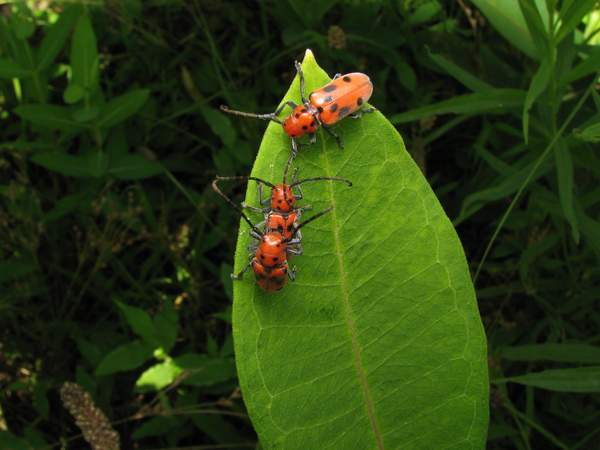
Red milkweed beetle (Tetraopes tetrophthalmus)
feeds on common milkweed
Moving on to other dependents we find beetles. We are most familiar with the milkweed longhorned beetle, often found on common milkweed. If we translate the scientific name of the most familiar one, Tetraopes tetrophthalmus, we would call it the four-eyed four-eyes, although it is known as the red milkweed beetle. The peculiar eyes of all the Tetraopes beetles are divided by the base of the antennae, hence the name. But it gets more complicated because instead of just one species there are at least 14 related and similarly looking species of four-eyed milkweed beetles. Each species sticks to only one or at most two species of milkweed. For instance, the red milkweed beetle feeds only on common milkweed, the red-femured milkweed borer on showy milkweed, and the blackened milkweed beetle on swamp milkweed.

The list goes on and on. It includes beetles of several families. For the sake of briefness see images of a few of them.

Swamp milkweed beetle larva (Labidomera clivicolis)
feeding on milkweed


Dogbane beetle. Larva feeds on dogbane or milkweed

Milkweed stem weevil (Rhyssomatus lineaticollis)
Larvae of several species feed on milkweeds

Small milkweed bug (Ligaeus kalmii)
Large milkweed bugs (Oncopeltus fasciatus)

Let us take a look at the milkweed bugs. The most familiar ones are the large milkweed bug (Oncopeltus fasciatus) and the small milkweed bug (Lygaeus kalmii). Curiously, despite their names, they are not entirely dependent on milkweed. They have been seen feeding on other plants, and even on other insects, in the case of the small milkweed bug.

Milkweed aphid (Myzocallis asclepiadis)
feeding on common milkweed

Several kinds of aphids attack milkweeds. Two of them are dependent on common milkweed. They are Aphis asclepiadis, and Myzocallis asclepiadis; no common name for these either.

All these and many more feed on milkweeds, some on only one species, others on several or many.

When we nurture monarch butterflies by planting milkweeds we are doing more than aiding the butterflies. We are helping the entire milkweed community or series of communities. The members of such communities or ecosystems interact with each other and, in turn, with a wide arrangement of other participants of this intricate play, such as neighboring plants and soil organisms. By preserving the habitat of monarchs, we are also preserving biodiversity. All species are important and we need to respect these communities and learn more about them.
Large milkweed bugs (Oncopeltus fasciatus)

See also:
Food Chain in the Milkweed Patch

 
References

Wednesday, May 08, 2013

Stinging Nettle. Food for Butterflies and Food for Us


I went for a walk yesterday morning, May 7, and noticed the nettles growing fast and furiously. The tender leaves are an invitation to gourmets who enjoy this healthy vegetable. I have never tasted it, but I think it is time to do so. I tried collecting a few leaves, but soon found out the sting was surprisingly powerful. I have picked up leaves in other occasions with little consequence. I may have to go back wearing gloves.

I found many recipes in the Internet. Garlicky pesto sounds promising. I will try that. Stinging nettle soup also looks tempting.

Early May is perhaps the best time to collect leaves. The plants are already tall and vigorous and, when I collected them yesterday, they seemed free from hungry visitors. However, I am surprised the next day when I look at the leaves in their plastic bag. They are now crawling with tiny aphids.  Last year I found aphids eagerly sucking juices from these plants on May 12. Close observation of the aphids under a microscope led me to notice the impressive structure of the stinging hairs. Interspersed among the regular hairs, considerably larger but still small enough to go unnoticed by the bare eye, the stinging hairs look remarkably different. They are shaped like hypodermic syringes and bursting with fluid, ready to pierce the passerby's skin.

Aphid and stinging hairs

Insect activity grew significantly by June of last year. These plants turned into a zoo of sorts. Aphids abounded on many plants. Large, fat caterpillars were feeding on leaves. Some were hiding within neatly folded leaves shaped as tents. Others had already turned into immobile, colorful chrysalides.
Red admiral caterpillar
Red admiral pupa or chrysalis
Adult red admiral

I was happy to learn that such caterpillars would turn into the lovely admiral butterfly. Nettles can feed several other varieties of caterpillars, the comma butterfly and the spectacular Io moth among them.
Comma butterfly on winter attire

Io moth © Anita Gould

In summary, stinging nettles can enrich a diet and be a worthy addition to a butterfly garden.

© Beatriz Moisset. 2013

Saturday, January 26, 2013

Plastics are not part of the web of life


A view of garbage.
Let me repeat this: Plastics are not part of the web of life. They do not truly recycle but downcycle. They inexorably accumulate despite the best efforts at recycling because the circle cannot be completed, so this cannot be called recycling. At best what we are doing is downcycling, modifying used plastics into lower grade plastics that can be used once or at most twice in some other form. After that, they reach the end of the line.


© DondeReciclo.org
The consequence is that plastics keep accumulating in the landscape. Horrific examples abound: dead albatrosses with stomachs full of plastic fragments; turtles and other wildlife chocked to death by plastic rings; fish full of plastic. Worse yet, the smaller fragments are out of sight, but not entirely out of the picture. Some may be inert but many others are potential carcinogens and toxins. If they are eaten by animals, they become part of the food chain. Are we eating our own plastic garbage? We probably are.

Dead albatross chick.
 What to do? We may not be able to eliminate plastics entirely. Some plastics are useful, even highly valuable and we don't have to give all of them up. But we could start with the disposable, one-use only plastics, such as grocery bags and water bottles. They represent the largest bulk of plastic waste and there are easy ways to cut down on their consumption.

One-use bottles
Two great books should be helpful if we commit ourselves to the task of plastics: "Plastics, a Toxic Love Story by Susan Freinkel gives abundant information on plastics, their history, uses and recycling."Plastic-Free:How I Kicked the Plastic Habit and How You Can Too" by Beth Terry is equally informative. It is also packed full of suggestions on how you can reduce plastic usage. It also provides numerous useful links.

As for me, I have been taking steps toward reducing plastics. I take my reusable bags wherever I go, not just to grocery stores, but also other stores. Sometimes the cashier of a book store or drug store automatically reaches for a plastic bag, without noticing that I am holding my bag in front of him or her. In such cases, I promptly stop them with a smile and tell them: "We have to help the environment any way we can". I say it loud enough that other people in the line can hear me. I used to be embarrassed, but no more. I do my best to be cordial and to emphasize the word "we".

When eating out, I carry my own container and bag. When the waitress offers a doggy bag, I tell her I don't need one. I am not surreptitious about it anymore. Once again I speak loudly about helping the environment.

Biodegradable plastics.
I still don't know what to do with all the grocery items that come in plastic containers; although I am beginning to keep track of "green" stores that make an effort to provide egg cartons rather than Styrofoam ones, cardboard salad containers and similar items. But there is still a long way to go.

What suggestions do you have

List of Articles

© Beatriz Moisset. 2013

Saturday, November 24, 2012

Milkweed's last hooray. Part two

Polished lady beetle (Cycloneda munda) on dying milkweed leaf

The milkweed food chain would be incomplete without predators and parasitoids. Most of them are out of sight in November; but a few are around feeding on whatever is available, mostly aphids.

Multicolored Asian lady beetle (Harmonia axyridis) pupa
Two species of ladybugs or lady beetles find abundant food on the dying milkweeds. A shiny adult polished lady beetle (Cycloneda munda) may be getting ready to hibernate. A little farther a pupa of the multicolored Asian lady beetle (Harmonia axyridis) stays still on a leaf. It is rather infrequent to find one so exposed. This one is darker than most pupae of this species, but as its name indicates, color variations abound. In another month it would become an adult, out of its pupa. It would turn out darker than most of its kind.

Multicolored Asian lady beetle adult


 Another type of aphid eater is present in numbers and feeds on the two species of aphids mentioned in the previous post. The larvae of syrphid flies are blind and worm-like, lacking legs. Despite these disadvantages, they have no trouble finding aphids to feed upon, provided that the mother was careful enough to lay her eggs near a growing and prosperous colony of aphids.
Syrphid larva (Eupeodes americanus)

It is impressive to see these maggots thrashing around until they find a plump juicy aphid. They hold it with their strong mouth parts and proceed to suck all the internal fluids until the prey is reduced to a deflated piece of skin. You can see the front end of the larva acting as a pump, expanding and contracting. Oddly, the other aphids in the colony have no fear, no premonition of what is in store for them. I have seen them approaching and then walking all over a syrphid maggot in total indifference.


Syrphid larva (Eupeodes americanus)
 
In a couple of weeks this will be all over. No more active life in the milkweed patch; just a few flying seeds carried by their fluff. The monarchs are long gone. All others remain in the area in hidden places safe from the weather and from the occasional winter predator. They will all return to their usual activities next year, when the milkweeds start sprouting new shoots and providing nourishment to them.


Milkweed's last hooray
List of articles

© Beatriz Moisset. 2012 

Tuesday, November 20, 2012

Goats Put to Service at Pennypack


If you go for a walk at Pennypack Ecological Restoration Trust, you may run into some unusual workers recently enlisted to deal with weeds.

My friend and I went there for a walk last Monday and came upon four goats inside an enclosure made of electrified wires. These handsome creatures were merrily munching away brambles, multiflora roses, and oh joy, poison ivy!

Three young men wearing green shirts with the Pennypack logo were putting the final touches on the signs alerting people about the electric wires. We were full of questions for them and were pleased to see them eager to talk.

They told us that restoration programs have started using goats to control invasive vegetation, particularly in the West, and also in Staten Island, New York. Sometimes goats are more effective and more economic than herbicides or weed-whacking. Thus, these fellows convinced the director to start a goat program at Pennypack.

The four goats arrived last Easter and were put to work a month later, after a period of acclimation. Until now they had been doing their weeding job in secluded areas out of sight of visitors. This was their first day in a more visible place by the main trail. It is the visitors' turn to get habituated to the goats and to begin to appreciate their restoration services.

Before and after. November 12, 2012
Before and after. November 16, 2012
Everyday, these eager workers are brought to a patch in need of clearing and left there until dark. They may have to return to the same spot the next day if they haven't finished the job. After that, they are gradually moved to other patches. The goats spend the night in a roofed shelter safe from coyotes. Did you know that there were coyotes in Pennypack? Now you do.

I returned four days later to inspect the progress. The enclosure had been moved a short distance from that of the first day. The happy animals seemed to never stop chomping away at brambles and vines. At first, it wasn't easy to tell what they had accomplished; but after I found my bearings I could see that, in fact, they had disposed of a significant amount of tangled vegetation. They had also munched on the bark of some tree branches. They are not to blame for being so indiscriminate. It is the human handlers' responsibility to place them only where they can do no harm to valuable native plants.

The plan is to restore the goat-cleared areas by replanting them with native plants. This method beats using herbicides. It also beats using human workers, especially when poison ivy is abundant or when the mats of vegetation are impenetrable. Bear in mind that goats may cause damage to valuable plants if given the opportunity; so precautions are needed.

I will continue checking periodically on these four legged employees of Pennypack.

Invasive vines waiting to be disposed of by goats
Beatriz Moisset.11/17/2012
© Beatriz Moisset. 2012

Thursday, November 15, 2012

Milkweed's last hooray


Striped garden caterpillar, Trichordestra legitima

It is November. We are deep into autumn. Monarch butterflies stopped feeding on milkweeds and are long gone from this area. Milkweeds are wilting, dropping leaves, some covered with sooty mold, and others reduced to dry stems and seed pods. Still they continue to nourish and shelter a number of species that depend on them.

A noctuid moth, the striped garden caterpillar moth (Trichordestra legitima), spends the winter as a pupa. An occasional caterpillar hangs around this late in the season taking advantage of the last scraps of food. Unlike monarchs, it is not choosy. This one happens to be feeding on common milkweed but others find nourishment in an incredible assortment of plants, from asparagus to yarrow or tobacco.

Oleander aphid, Aphis nerii

Aphids are busy sucking juices from the few remaining green stems and leaves of milkweeds. Their colonies are usually considerably larger this time of the year. The most frequent species on common milkweed is the oleander aphid (Aphis nerii), a bright yellow-orange one.

Myzocallis asclepiadis
Less common is the aphid called only by its scientific name, Myzocallis asclepiadis, about the same size as the oleander aphid, almost translucent, with dark dots and often seen sharing plants with its more colorful relative. Myzocallis asclepiadis specializes on Asclepias, as its name suggests. The oleander aphid has broader tastes, living on other members of the dogbane family (Apocinaceae), as well as occasionally some plants of the potato family. This aphid is not native to this hemisphere, and, curiously, there are no males in the North American populations, so they only reproduce parthenogenetically or by virgin birth.

Labidomera clivicollis, larva
Labidomera clivicollis
 A colorful beetle, the swamp milkweed leaf beetle (Labidomera clivicollis) is not as selective as its name indicates and also feeds on common milkweed, as this larva was doing. It is unusual to find a larva still feeding in November. There was an adult nearby.


large milkweed bug, Oncopeltus fasciatus
A common denizen of dry and dying milkweeds is the large milkweed bug (Oncopeltus fasciatus). Both adults and juveniles (called nymphs) feed on seeds of this plant as well as leaves. So it is not surprising to see them in large numbers in November.
Soon all these milkweed visitors will be gone, too. The one that will remain will be the longhorned milkweed beetle (Tetraopes tetrophthalmus). Its larvae will remain buried underground feeding on roots and waiting for next spring.


Beginners Guide to Pollinators and Other Flower Visitors

© Beatriz Moisset. 2012