Tuesday, May 22, 2012

No Tree is an Island

The small seed fell on the fertile soil. After a rest period it swelled and burst out of its case. It lifted its head and began to grow, enjoying the sunshine and the rain water that penetrated the ground and bathed its small roots. After a number of years, it became a significant member of the forest, as large as some of its companions. It had become a tree. And that is what we will call it from now on: Tree.

Tree follows an annual routine, each spring it covers itself with flowers, the agents of a special contract with insect partners. It lures these partners with the perfumed and brightly colored flowers. Tree provides them with nectar and pollen and makes use of them to have its pollen carried to other members of its species. The tiny partners are unaware of the pollination service they provide. Tree uses them for its own purposes, to ensure the next generation and pays them handsomely.

Once the flowers are pollinated, fruits grow, with seeds inside that will complete the process of starting another generation. When the seeds are ready, Tree resorts to other kind of attractants to call a second set of partners. The fruits ripen, become sweet and nutritious and their colors turn bright inviting birds and maybe squirrels or other small creatures as well as larger ones. Tree provides them with sugars and vitamins, to induce them to carry the seeds some distance, so Tree's descendants can spread far and wide.

Tree has relationships with many other members of the forest. Some are not so friendly; they can even be costly.  Tree resorts to other items in its tool kit, including weapons and even hiring some allies of a different sort. Multiple creatures feed on the leaves and other tissues of Tree. Most of the time they don't cause serious damage because Tree uses its defenses to be unpalatable, thus repelling a good number of them or limiting how much they can eat. If things get out of hand Tree resorts to another defense: it calls helpers, parasitic wasps, ready to lay their eggs on the damaging insects, thus bringing down their populations and the damage that they might inflict on Tree otherwise. If that defense isn't enough, Tree can count with the help of several other enemies of its enemies, ladybugs, lacewings and a few others. Tree doesn't know it, but even its enemies may provide it some benefits. Some of them end up feeding the very birds that at other times take care of dispersing Tree's seeds. So, it would be more appropriate to regard them as taxes, that necessary evil, rather than enemies.

Thus, Tree is intertwined to the life of the forest in multiple ways above ground. It is time that we take a look below ground, where the web of life is just as intricate or even more so.

There are certain fungi, called mycorrhizae, that partner with Tree in an intimate way. They are composed of very thin threads similar to rootlets but thinner and far more abundant. They form an endless mesh wrapping around Tree's roots and even penetrating them. They are not a threat but helpers. They dramatically increase the reach of Tree's rootlets and they are far superior at extracting water and essential minerals from the soil.

They render some of these to Tree which, in return, pays its partner with nutrients produced by its leaves. Not satisfied with that, mycorrhizae reach out to other trees and plants, providing similar services. The remarkable thing is that they have the faculty of carrying nutrients from one plant to another when a particular one is under stress and the others are doing well. Thus, the partnership goes well beyond Tree to the entire community.

Mycorrhizal interconnections don't stop there. They also interact with a variety of soil bacteria. These bacteria, too, are very good at producing an assortment of chemicals, some of them useful to the mycorrhizae and also to Tree.

When mycorrhizae want to reproduce, they form the familiar mushrooms often seen on the forest floor. Other mycorrhizae produce truffles instead. Now, it is time for another partner to enter the scene. The mushroom or truffle is nutritious to many forest creatures, beetles, squirrels, flying squirrels. They seek the mushroom or truffle's flesh, swallowing some spores along with it. Later on, they pass the spores at some distance, where new mycorrhizae can grow away from the parent and develop a relationship with other plants.

Tree sheds its leaves every year. These would accumulate to the point of smothering the soil if it wasn't for the work of other helpers. A wide array of insects, fungi, bacteria, nematodes slowly chews away all this matter. It takes them years to return all the nutrients to the soil but they accomplish this task.

I probably left out many other partners of Tree. But this could suffice for now. We can firmly conclude that no tree is an island. No other creature is an island either, all joined together in the Web of Life.


© Beatriz Moisset. 2012

Tuesday, May 08, 2012

Poop Flinging and Other Poop Strategies


Caterpillar shelter
Many insects eat rather non nutritious plant parts. So they need to consume large amounts, extract the nourishment, such as proteins, and discard the rest at the other end. In simpler words: they eat a lot and poop a lot, or if you prefer, they produce large amounts of frass or waste material.
Wasps are some of the worst enemies of caterpillars. They are constantly seeking them to feed their young. Many wasps are superb at controlling insect pests. I would think twice before hurting one of them; they are our friends. Without them, there would be population explosions of plant-eating caterpillars.

Leaf-roller caterpillar and its frass
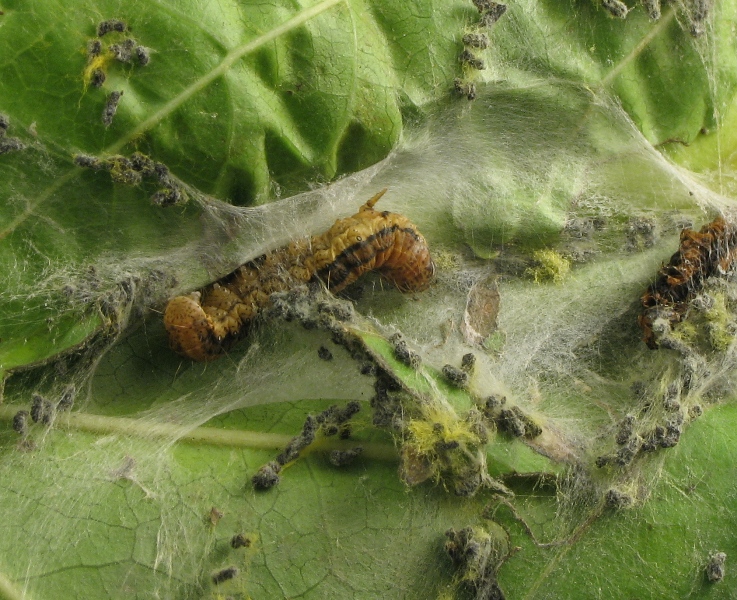
Caterpillars have devised different ways to hide and keep these ferocious predators from finding them. The so-called leaf-rollers fold a leaf, stitch it together with their silk and stay inside the little tunnel munching away in relative safety. The amount of frass that accumulates inside these little shelters can be impressive. One wonders how they can live in such conditions. Not pretty!


Tiny black dots of frass hurled by caterpillar
Unfortunately for the caterpillar, the smell of their poop is an excellent clue to their presence. You may say that predatory and parasitic wasps have a nose for food-related aromas. So, certain caterpillars have developed a singular strategy. They throw their waste material as far as they can; which can be pretty far. Eight to twelve inches for a caterpillar not much bigger than a grain of rice! That is as if you could throw the you-know-what several yards away.

The curious thing is that many moths and butterflies belonging to different families have come up with the same poop-flinging solution to hide from predators. Among them there is a skipper that you may probably have seen visiting flowers, the silver spotted skipper. It gets its name from the brilliant spot on its hind wings. When this skipper was a caterpillar it regularly shot cannon balls of its own frass as far as a couple of yards away. How about that!
Silver-spotted skipper


Orchard Swallowtail caterpillar 3148
Bird-dropping caterpillar
(by Malcom NQ, Flickr)
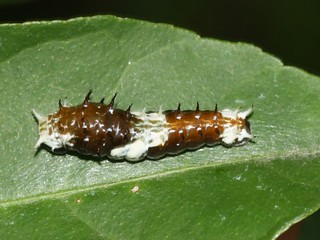
Another poop strategy of sorts is that used by many caterpillars called bird-dropping caterpillars. Their appearance, as the name tells you, resembles a bird dropping. Apparently the ruse is convincing enough to discourage would be predators. No real poop is involved here, but it is worth mentioning in an article about poop strategies.


Leaf beetle larva hiding under its poop
And then, there are other insects, particularly a group of leaf beetles that have turned things around completely. Instead of leaving their poop behind, they proudly carry it around as a shield. Some build a sort of basket or nest above and around them. Others have a projection shaped like a coat rack, from which they hang their byproducts, castoff skin and poop. You can read more about one of them in The Poop Bug and the Golden Beetle

More on frass strategies
 
List of articles 

© Beatriz Moisset. 2012

Tuesday, March 20, 2012

Food for wildlife

Jan van Huysum. Blumen und Früchte

I invite you to look at this floral painting by the Dutch artist, Jan van Huysum, and find the connection between it and the title of this blog. Look carefully and visit the enlarged version.

Signs of feeding insects

After reading Doug Tallamy's book Bringing Nature Home, I began to see plants with new eyes. The main focus of the book is the importance of native plants in sustaining the food chain by feeding insects and, by extension, all the wildlife that feeds on insects. He points out that, fortunately, insect feeding damage tends to be moderate, as long as the natural systems are in balance. Insects make a little hole here, a little hole there on leaves; or eat an entire leaf; aphids sap juices from plants, etc. But the appearance of the vegetation is not greatly affected and most plants survive and prosper despite such attacks.

A leaf roller caterpillar hiding inside a leaf

Soon after I finished the book, I went on a trip to the Great Smoky Mountain National Park. I noticed, for the first time, something that probably nobody else in my group was aware of. Insects had left traces of their feeding just about everywhere. But, just as Doug mentioned in his book, none of the damage was serious. I saw little holes grouped together, larger holes on other leaves. I saw leaves with nibbled out edges. I saw leaves with translucent spots where the insects had scraped the nourishing in-between tissues, leaving only the outer surface of leaves. I also saw some skeletonized leaves, where only the inedible veins remained. There were some sap-feeding insects here and there, leaf roller caterpillars, interesting galls.

Sometimes I saw a caterpillar hanging from a thread, probably fully grown and ready to bury itself underground to pupate. I know that, for a caterpillar to reach full size, it must have eaten a handful of leaves. I also know that where I see one caterpillar there may be dozens cheerfully disposing of many leaves. So I looked at the canopy and couldn't detect any damage. The foliage overhead was luxuriantly rich and full.

So, it is quite true, the forest feeds the insects and they, in turn, feed all kinds of creatures, big and small. Birds, squirrels, chipmunks, frogs, toads, and lizards take advantage of this rich protein source. Even bears gobble up caterpillars. As long as the ecosystem is healthy, with a good balance of native plants and native animals, you seldom see serious damage. This balance can be disrupted by non-native plants. If they are indigestible to native insects, they suffer no damage; but also they fail to become part of the food chain. They provide no service to the ecosystem that supports them.

Dead hemlock trees

The ecological balance can also be altered by non-native plant feeders, and we saw an example that same day. We arrived at a grove of hemlock trees where the situation was dramatically different. The stately trees ere reduced to skeletons, devastated by a pest. Some were already dead; others were dying. An insidious insect from Asia, the hemlock woolly adelgid, has been accidentally introduced in eastern North America. In its native land this tiny, aphid-like insect causes only moderate damage to the Asiatic hemlocks. The natural resistance of the host plants and other natural controls keep nature in balance. But in this continent the checks and balances are missing; so the adelgid can become a pest that devastates the defenseless trees.

Getting back to the floral bouquet, Dutch artists of the sixteen and seventeen centuries loved to include insects and other small animals into their flower arrangements, not just pretty butterflies but other less popular creatures. They were realistic to the point of showing blemishes on leaves and fruits and also some of the makers of that minor damage.
Jan van Huysum (detail)
 Here is a detail near the bottom of the above painting: a caterpillar on a half eaten leaf. Another example of partially eaten leaves is shown on Balthasar van der Ast's "Still Life with Flowers, Fruit, and Shells"

Balthasar van der Ast. Still Life with Flowers, Fruit, and Shells

You can see the uncropped painting. Then amuse yourself searching for caterpillars or signs of insect feeding on the following Dutch paintings: 1, 2, 3 and 4.

Afterwards, take a walk in the forest and look for similar signs in the foliage. I don't regard them as blemishes any more because they are important components of the web of life. Visualize the caterpillar that made the holes and imagine a parent bird catching the caterpillar to feed its hungry brood.

List of articles

© Beatriz Moisset. 2012

Thursday, March 08, 2012

Mycorrhizae and the web of life

A squirrel feeding on mushroom

The role of mycorrhizae in the garden

Mycorrhizae, the symbiotic fungi that feed on organic matter from green plants and, in return, supplies them with water and minerals, is an essential part of an ecosystem. More than 80% of all land plants depend to some extent on mycorrhizae.

In turn, mycorrhizae need the help of some animals to spread the spores. The squirrel is one of these friends of mycorrhizae. By eating mushrooms, the fruiting bodies of mycorrhizae, they take in spores and pass them through their intestines, depositing them later on far from the mother fungus.

A mycorrhizal mushroom

There are opportunists that take advantage of others, in nature as well as in human society. Some green plants have lost their chlorophyll; so they obtain their food from others. This is the case of Indian pipe, a small whitish plant growing among the leaf litter. The above ground part of the plant is just a stem with a few highly reduced and useless leaves and a flower that bends down resembling a pipe, hence the name. Indian pipe's roots extract nutrients from the mycelium of fungi, most commonly mycorrhizal fungi. They, indirectly parasitize the trees that nourish the mycorrhizae.

Indian pipe, a parasitic plant

Root Partners. Mycorrhizae

List of articles

© Beatriz Moisset. 2012

Monday, January 09, 2012

Root Partners, Mycorrhizae


The remarkable partnership between plant roots and fungi called mycorrhizae is worth studying. A mushroom is a lot more than a mere addition to the forest floor. Learn more about mycorrhizae


Mycorrhizae, 1
Mycorrhizae, 2 

© Beatriz Moisset. 2012

Sunday, November 06, 2011

Land of the Jaguar

Enter a Google search at your own risk. You may emerge from it hours later, bleary eyed and stiff jointed, when your body demands food and a bathroom break.
I had this experience recently while doing a translation from Spanish to English about the jaguar in Argentina. There are between 200 and 300 of these magnificent animals left in this country and the numbers keep dwindling. A few very dedicated lovers of the jaguar are doing their best to save it from extinction in Argentina. They call themselves "Red Yaguarete" (Jaguar Network). As part of their efforts they raise public awareness through publications so I help them periodically with translations to English.
Recently, they focused their interest on a large ranch in northern Argentina and the possibility of turning it into a national park. The group is trying to convince the government and the public of the benefits of such action. The ranch "Estancia La Fidelidad" is a large property. At 618,000 acres it is similar in size to The Great Smoky Mountains National Park (521,000 acres) and the Petrified Forest National Park (93,500 acres) combined. Located in the Dry Chaco in northern Argentina, it is crossed through the middle by the Bermejo River, one of the larger rivers of the area. Dry Chaco is a harsh land, hot and dry, with low human population and still relatively rich wildlife. A few rivers carrying water from the eternal snows of the Andes Mountains cross the region. The land is so flat that they spread widely in some areas creating wetlands rich in wildlife. It is in these places that the jaguar finds abundant prey and prospers.
Recently, as part of their efforts, "Red Yaguarete" surveyed the native flora and fauna of the ranch by jeep and by canoe, subsidized by their own funds. This is the report I am translating.
Google proved extremely useful. Through searches I learned that the "carpintero de los cardones" is called "White-fronted Woodpecker" and that the "oso hormiguero bandera" is the "giant anteater". But then, I wanted to know more about the reasons why this large ranch had become available. What had happened to the owners? Google obliged by giving me more than 62,000 entries, practically all of them in Spanish, for "Estancia La Fidelidad" including maps and videos.
A recent newspaper article caught my attention. The owner of the property and his widowed sister-in-law, who lived with him, were brutally assassinated last January by unknown people. Manuel Roseo was an older Italian immigrant, who lived in a very modest residence, although his huge property was valued at 200 million dollars. In the months preceding his death he discovered that somebody was using false papers and selling some of his land. He started investigating this matter and it is possible that this led to his murder. The story has all the makings of a mystery novel. It would be incomplete without some illegitimate children who could claim the inheritance. Not surprisingly there is a woman who says that her teenage daughter and eight year old son are Roseo's children.
So many questions! How did a poor Italian immigrant come to own this valuable land? Why did he continue to live like a day laborer? What was his relationship with his sister-in-law? What about the other woman and the possible heirs? And, who was selling his property behind his back? By adding the word "asesinato" (assassination) I could locate more than a thousand entries about the subject; not that they provided any clear answers to the mystery. I had to stop.
The next day I resumed my translation. Soon I needed to search another word in Google. This time my quest led me to a book published in the 1850s, an early survey of the Argentinean and Paraguayan Chaco, including descriptions of the land, flora and fauna and the peoples of that time. Thomas Jefferson Page, grandson of the American president was a ship captain commissioned by the United States to do a survey of the land north of La Plata River. He traveled the main rivers up north, all the way to Paraguay in his ship the "Water Witch" during the years 1853 to 1856 making maps and taking detailed notes, including some diplomatic activities along the way. The entire text of his book is available as an e-book and quite enjoyable and easy to read.
Thomas J. Page described some of the plants and animals and the lay of the land of a large part of the Dry Chaco. All this was useful for my purposes. It also covered many other matters, which I couldn't stop reading. He befriended the Argentinean president, general Urquiza, and gave him a ride up the La Plata River in his ship.
He attended a dance of the little angel ("Fiesta del angelito"). This is a peculiar tradition of several South American countries. When a child dies, the little body is dressed in the finest clothing and sat on a small chair, high in an altar decorated with candles and flowers. The parents and guests dance merrily all night and may even lend the little angel to other friends and relatives for subsequent celebrations until decay puts an end to this. The thinking is that heaven rejoices at the arrival of such a pure soul and that the family should be grateful that the baby went straight to heaven without enduring the trials and tribulations that the rest of us cannot escape. Needless to say, Google provided abundant entries to the search "Fiesta del angelito" that could take hours to read.
Thomas J. Page went so far north that his ship entered a region where the national borders had not been settled yet and Paraguay considered as part of their country. He was taken prisoner and released few days later; his maps were confiscated.
It was time to put this reading aside and to get back to my translation. One final tidbit, though: Thomas Jefferson Page went back home to Virginia; soon the Civil War broke up and he joined the Confederate navy. I had so many questions: Did he own slaves? Did he pass his genes to some of them the way his grandfather did? What did he think of Argentina, where slavery had been abolished the year of his arrival and where mixed race marriages were not uncommon?
More Google searches were in order. But, I really had to go now.

List of articles

Sunday, August 14, 2011

Utilities right-of-way. Native plants

Horsham Trail. Utilities right-of-way. Too much lawn, perhaps

Why don’t we turn all the utilities right-of-way lands into oases for wildlife? Am I a dreamer? I hope not. Near my home, a several miles long trail runs under high-voltage wires. When I walk there I see joggers and bikers, mothers pushing baby carriages, and walkers, just like me. The surroundings are pleasant, just a tad artificial, not quite a nature area; although closer to a nature area than busy noisy streets.

A corn field next to the utilities right-of-way
Horsham Trail

How much work and investment would it take to turn such areas into natural or semi-natural ecosystems? Perhaps, with careful planning, they would be easier and cheaper to maintain if they were allowed to become more natural.


Restored native grasses at Pennypack Restoration Trust
An example of what can be done

For instance, most of the lawns near the trail could be turned into wildflower meadows. The lawn closer to the trails could be allowed to support many broad leaved plants; accepting them as grass companions rather than treating them as weeds. It would be helpful to replace the non-native trees already planted with native ones, which are considerably better at supporting wildlife.


"Unkempt" lawn with wildflowers which attract butterflies.
Horsham trail


Some of these measures may be expensive at first but, ultimately, they would save money and upkeep time because native vegetation has evolved in that particular kind of soil and climate and is best suited for it. It also has co-evolved with the other members of the community. Native plants support more wildlife, including butterflies and birds, thus beautifying the land, in addition to improving the ecological balance. All and all it is a win-win situation.

List of articles

Invasive species

I do not hate invasive species

This article expresses my opinion on introduced species that become invasive. The species themselves are fine; what is problematic is our intentional and unintentional carrying plants and other organisms to other lands. This has given rise to an incredible large number of transplanted species that continue to alter ecosystems beyond anything that we could have imagined. The impact of introduced species on ecosystems continue to have all sorts of unintended consequences.

Sunday, July 24, 2011

Wildlife Food and Non-native Plants

Queen Anne's lace and many visitors. What is it replacing?

I worry sometimes when people insist on seeing the merits of some introduced plant and claim that it is good for wildlife. We are all familiar with butterfly bush attracting butterflies and with the berries and rose hips of several alien plants which feed the birds. I have also seen Queen Anne’s lace blossoms covered with flower visitors. Another example is this blog article about English ivy and pollinators: Pollinators aplenty: English Ivy mixed blessings. The author tells us that the English ivy in his property is attracting numerous pollinators at a time when there aren’t any native flowers. He suggests that we “should step back and view non-natives with less disdain until we understand better what roles they now play in their adopted habitats.”

I think that this philosophy shows a lack of understanding of ecosystems and of what is missing in those that have been altered by humans. We tend to think that habitat loss is something far away, clear-cutting in the Amazon, for instance. We seem to forget that the urbanization and suburbanization of the areas where most of us live are representatives of a huge amount of habitat loss.

When pollinators and birds resort to non-native flowers and berries, it is because the habitat has been severely disturbed and the native plants that were supposed to sustain them are lacking. A healthy habitat is an assemblage of co-evolved and synchronized plants and the wildlife that feed on them. The absence of such plants is a very sad indication that the ecosystem has been dramatically disrupted.

Calling non-native plants beneficial to wildlife is ludicrous. They are merely acting as prosthesis. If I had a leg amputated, I too would sing the praises of a high quality prosthesis, no matter how alien to my body it was. But, I would prefer my own, native and co-evolved with my body, original leg.

Butterfly bush provides nectar to butterflies but very little else, unlike many native plants
Let us not be seduced by the fact that some introduced plants are used by wildlife. Normally, the natives do that job a lot better, plus they provide countless other services to the ecosystem. We are barely beginning to understand the very complex interactions between all the members of a living community. It is becoming apparent that most of them are missing when we mix organisms from all sorts of places.

More on the subject: I do not hate invasive species

List of articles

Tuesday, July 19, 2011

Viburnum leaf beetle, an introduced pest

The viburnum leaf beetle (Pyrrhalta viburni) was introduced accidentally along with non-native ornamental viburnums from Europe and Asia. It took perhaps a hundred years for it to become settled and to start multiplying in noticeable numbers. By then it had found out that native viburnums, such as arrowwood, were good to eat and lacked defenses against them. The consequences were, perhaps, unavoidable; the beetle is spreading across North America ravaging native viburnums.
Adult viburnum leaf beetles © Beatriz Moisset

Read the whole article:
Viburnum under siege
Viburnum under siege. Part 2


Leaf damage caused by the larvae on arrowwood viburnum  
© Beatriz Moisset


Larva and leaf damage. © Beatriz Moisset

Egg cases © Beatriz Moisset

List of articles